文 / HuSir
在这个AI应用遍地开花的时代,人们每天都在讨论技术迭代、效率提升,以及未来会发生怎样的变化。但很少有人意识到:我们如何使用AI,其实正在暴露人类长期以来一种更深层的思维问题。很多人以为,AI的出现只是一次技术革命;但从某种意义上说,它更像是一面镜子。它照出的,不只是机器的能力,更是人类自身长期形成的“被动思维”。
人其实在骨子里是懒惰的。从十几年的学校教育开始,人们就逐渐习惯了一种“任务驱动型”的生活方式:老师布置任务,学生完成;公司下达KPI,员工执行;社会制定规则,人们照着运行。久而久之,大多数人最习惯的做事方式便成了:“别人告诉我做什么,我再去完成什么。”而且,人们往往希望自己的付出,能够得到符合预期甚至超出预期的结果;一旦短时间得不到反馈,便不愿继续深究;一旦感觉困难太大,就会提前在脑海里“假想失败”,然后选择放弃。这种长期形成的被动模式,正在让越来越多的人失去一种能力——主观能动性(Agency)。
什么是主观能动性?简单来说,就是一个人愿不愿意主动理解问题、主动拆解问题、主动寻找路径,并主动推动事情向前发展,而不是永远等待别人安排。很多人进入职场后,其实都会遇到一种状态:一旦没有人给自己分配任务,就忽然不知道该做什么了。因为长期以来,人们已经习惯被规定、被考核、被管理、被推动。甚至很多大学教育也是如此。研究领域越来越专业、越来越细分,人们却反而越来越缺少一种“全面质疑”的能力。很多人可以熟练掌握一个极其狭窄领域里的知识,却缺少主动理解整体世界的能力。
而这种问题,在AI时代会被迅速放大。因为AI并不是一个“自动替你思考”的工具。恰恰相反,它越来越像一个“放大器”:你的主动性有多强,它反馈给你的结果就会有多深。很多人抱怨AI“没用”、“流于表面”、“回答太空”,其实问题很多时候并不在AI,而在于使用者自己。因为真正高质量的AI使用,并不是随便丢一句话过去,然后等着奇迹发生。它需要一个人真正开始主动思考。你首先需要知道自己真正想要什么、知道问题的背景是什么、知道哪些地方自己不明白、知道期望得到怎样的结果。接下来,还需要围绕目标不断互动、修正、补充、推敲。只有当你愿意把自己的需求、背景、现实处境与真实想法充分表达出来时,AI的资料整合能力、逻辑推理能力、归纳总结能力,才会真正被激活。
这个过程,其实不仅仅是在“使用AI”,更是在重新训练一个人的思维方式。因为人在这个过程中,会被迫开始主动表达、主动分析、主动厘清问题、主动寻找方向。而这,正是主观能动性的开始。
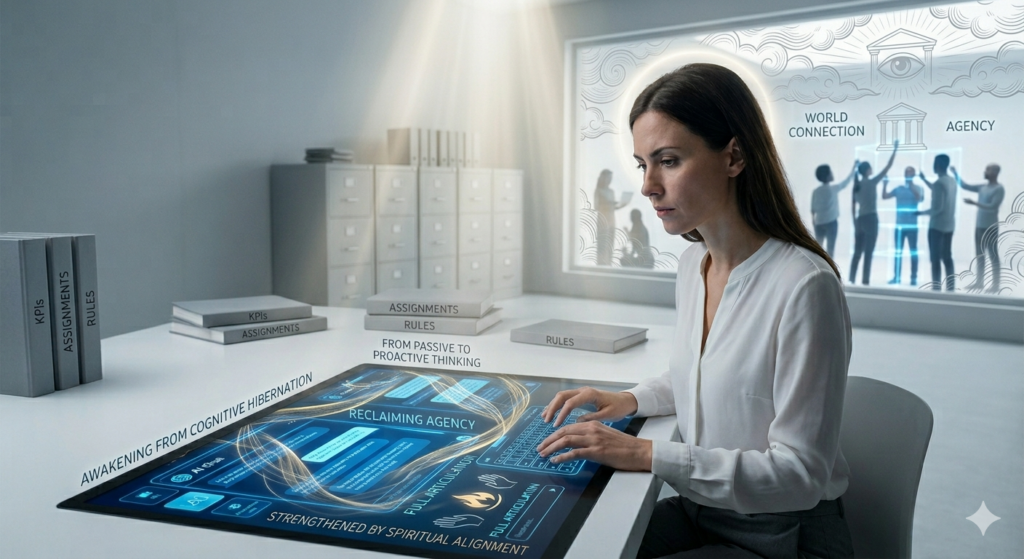
有趣的是,这种能力不仅适用于AI,也同样适用于人与人之间的沟通。现实生活中,很多人总觉得“别人不理解我”,但问题往往在于:他自己其实从未真正把内心的想法完整表达出来。很多人与AI初期使用者的问题非常相似:不愿意耐心说明背景,不愿意深入表达真实需求,却期待对方能够100%甚至200%地理解自己。这种期待,其实是很矛盾的。无论是人与人之间,还是人与AI之间,高质量的互动,往往都建立在“真实表达”之上。而这种“和盘托出”的能力,本身就是一种成熟。因为真正的沟通,并不是猜谜游戏,而是愿意把真实的自己慢慢打开。
如果再往更深一层延伸,这种“主观能动性”的练习,其实同样适用于人与神之间的关系。很多人的信仰,其实也是被动的。他们把神当作有困难时才临时寻找的帮助,或者一种情绪低谷时的精神安慰。但真正的信仰,并不是被动等待神“自动改变自己的人生”,而是主动地与神建立真实关系。而这种主动性的练习,很多时候就体现在祷告与反思。当一个人愿意在安静中,把自己的困惑、欲望、恐惧、软弱与真实想法坦诚地带到神面前时,这其实也是一种“和盘托出”。而人在这种真实的祷告与反思里,往往会慢慢重新整理自己的内心。很多时候,人并不是在祷告之后立刻得到答案,而是在之后的生活里,慢慢被带领着看见方向。正如圣经所说:“你祷告的时候,要进你的内屋,关上门,祷告你在暗中的父;你父在暗中察看,必然报答你。”——《马太福音》6:6
因此,AI时代真正重要的问题,也许并不是“AI会不会取代人类?”,而是“人是否愿意重新学会主动思考?”因为AI并不是让人放弃思考的麻醉剂,反而更像是逼迫人重新恢复思考能力的催化剂。世界正在越来越奖励那些愿意主动探索、主动表达、主动承担、主动思考的人。而那些长期等待别人安排、等待别人理解、等待别人推动的人,则会越来越容易陷入迷茫。所以,真正重要的,也许并不是你是否拥有AI,而是你是否愿意走出思维的冬眠。是否愿意开始主动面对问题、主动表达真实、主动理解世界、主动与人连接、也主动与神同行。因为很多改变,往往就从这种“主动的一步”开始。
Awakening from Cognitive Hibernation: Reclaiming Agency in the Age of AI
By HuSir
In an era where artificial intelligence applications are expanding at a breakneck pace, public discourse remains heavily fixated on technological iteration, efficiency gains, and the looming uncertainties of the future. Yet, few have paused to realize a more profound truth: how we engage with AI is putting a spotlight on a deeply ingrained flaw in human cognition. Many view the rise of AI merely as a technological revolution. In a more significant sense, however, it serves as a mirror—one that reflects not just the capabilities of the machine, but the chronic passive thinking of humanity.
Indolence, it seems, is wired into our core. Conditioning from decades of formal education has accustomed most to a purely “task-driven” existence: teachers assign homework, students complete it; corporations dictate KPIs, employees execute them; society establishes rules, and people follow the track. Over time, the default operational mode for the majority becomes a simple echo: “Tell me what to do, and I will do it.” Furthermore, we expect our efforts to yield results that perfectly match, or even exceed, our expectations. Yet, if feedback is not instantaneous, we lose the will to investigate further. The moment a hurdle appears too formidable, we mentally conjure our own failure and preemptively throw in the towel. This prolonged passivity is eroding a vital human faculty—subjective agency.
What exactly is agency? Put simply, it is the willingness of an individual to proactively understand a problem, deconstruct it, chart a path forward, and drive a situation toward resolution, rather than perpetually waiting for external direction. This explains a common phenomenon among the modern workforce: the moment employees are left without a prescribed checklist, they are suddenly at a complete loss. They have been conditioned to be defined, audited, managed, and pushed. Higher education is hardly immune to this trend. As academic research becomes increasingly hyper-specialized and siloed, it inadvertently stifles the capacity for holistic, critical skepticism. While many can master an exceptionally narrow niche of knowledge, they lack the drive to comprehend how the broader world hangs together.
This cognitive deficit is magnified exponentially in the age of AI. Artificial intelligence is not a tool designed to do your thinking for you. On the contrary, it acts as an amplifier: the sharper your proactive drive, the deeper the feedback it returns. Many complain that AI is “useless,” “superficial,” or “prone to platitudes,” but the fault rarely lies with the technology; it lies with the user. High-quality interaction with AI requires far more than tossing a casual prompt into a chat box and expecting a miracle. It demands that an individual initiate rigorous, independent thought. You must first know what you genuinely want to achieve, understand the underlying context, identify your own blind spots, and clarify your target outcome. From there, you must engage in an iterative process of dialogue, refinement, and calibration. Only when you are willing to comprehensively articulate your needs, background knowledge, and real-world constraints will the AI’s true capabilities—its data synthesis, logical reasoning, and analytical summarization—be unlocked.
This process is ultimately less about “using AI” and more about retraining the human mind. It forces an individual into a cadence of active articulation, analysis, problem-clarification, and strategic direction. This is precisely where agency begins.
Fascinatingly, this dynamic applies just as potentially to human-to-human communication. In daily life, a ubiquitous grievance is, “Nobody understands me.” Yet more often than not, the aggrieved party has never actually articulated their internal thoughts with any degree of clarity. The flaw mirrors that of a novice AI user: they are unwilling to take the time to explain their context or communicate their authentic needs, yet they expect the other person to read their mind and deliver a flawless response. Such an expectation is fundamentally contradictory. Meaningful connection—whether between humans or between human and machine—is built entirely on authentic expression. The ability to lay one’s cards on the table is a hallmark of emotional and intellectual maturity. Real communication is never a guessing game; it is the conscious willingness to gradually open up who you truly are.
If we take this exercise of agency a step further, it extends seamlessly into the spiritual realm. For many, religious faith has also devolved into a passive enterprise. They treat the divine as an emergency exit during a crisis or a psychological sedative during an emotional valley. True faith, however, is not a passive waiting game for God to automatically fix one’s life; it is an active pursuit of a genuine relationship. This proactive discipline is most clearly expressed through prayer and reflection. When an individual steps into a quiet space to candidly bring their confusion, desires, fears, and vulnerabilities before God, they are engaging in the ultimate act of laying themselves bare. Through this unfiltered vulnerability, the human heart begins to realign itself. Clarity is rarely delivered as an instant answer following a prayer; rather, one is gradually led to see the path forward unfolding within the rhythm of daily life. As the Gospel of Matthew beautifully captures : “But you, when you pray, go into your room, and when you have shut your door, pray to your Father who is in the secret place; and your Father who sees in secret will reward you openly.” (Matthew 6:6 NKJV)
Therefore, the defining question of the AI era is not “Will AI replace humans?” but rather, “Are humans willing to relearn how to think for themselves?” AI is not a narcotic designed to numb human intellect; it is a catalyst forcing us to resuscitate it. The world is increasingly moving to reward those who choose to explore, articulate, take ownership, and think proactively. Conversely, those who spend their lives waiting to be directed, waiting to be understood, and waiting to be pushed will find themselves increasingly adrift in a fog of confusion. Ultimately, what matters is not whether you have access to AI, but whether you are willing to awaken from your cognitive hibernation. It is a question of whether you are ready to proactively confront challenges, voice your truth, understand the world, connect with others, and walk intentionally with the divine. After all, every meaningful transformation begins with that first, proactive step.