
文 / HuSir
最近一年多,我发现一个有趣的现象。许多四五十岁甚至六十岁左右的朋友,一提到人工智能,往往都会表现出浓厚兴趣;但一谈到 AI Coding(AI编程),他们马上就退缩了。他们最常说的一句话是:“我不会编程。”
这句话听起来似乎很有道理。毕竟在过去几十年里,编程一直被视为一种专业技能。人们的印象中,程序员需要学习复杂的计算机语言,需要记忆大量语法规则,需要面对密密麻麻的代码窗口。对于已经离开学校多年的普通人来说,这似乎是一座难以跨越的大山。
但如果认真观察最近两三年人工智能的发展,就会发现一个重要变化:今天的 AI Coding,正在逐渐改变“先学编程,再做软件”的传统路径。
过去,一个人想开发软件,首先要学习编程语言。无论是 C++、Java、Python,还是网页开发中的 HTML、CSS 和 JavaScript,都需要花费大量时间学习。很多人还没有开始真正做项目,就已经被各种教材和课程消耗掉了热情。
然而今天的情况正在发生变化。越来越多的人不是先学编程,而是先解决问题。在这个过程中,他们借助 AI 完成代码编写,再逐渐理解程序运行的逻辑。换句话说,过去是“学会编程才能做事”,而现在则越来越像“为了做事而逐渐学会编程”。
这两种路径看似相似,实际上却有本质区别。
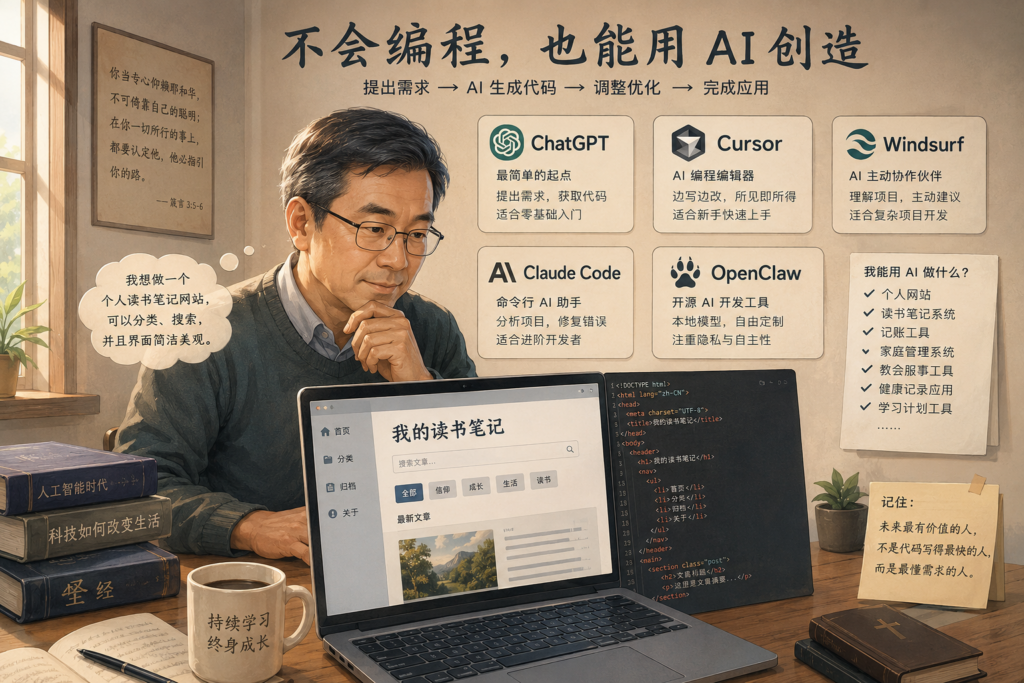
举一个简单例子。假如一个退休教师希望建立个人网站,用来记录自己的读书心得。按照传统方式,他可能需要先学习网页设计、服务器知识、数据库知识和编程语言,然后才能开始搭建网站。很多人在这个过程中就放弃了。
而今天,他完全可以打开 ChatGPT 或 Claude,对 AI 说:“请帮我制作一个简洁的个人读书网站,首页显示文章列表,每篇文章可以分类管理,并支持搜索功能。”
几秒钟之后,一套完整代码便会出现在眼前。即使看不懂代码,也可以直接复制保存,运行后立即看到效果。随后再不断提出新的修改意见,例如调整颜色、增加栏目、优化排版,AI 都会协助完成。
这就是 AI Coding 带来的最大变化:人开始用自然语言与计算机沟通,而不是必须先掌握复杂的程序语言。
在目前众多 AI Coding 工具中,Cursor 可以说是最适合普通人入门的产品之一。它本质上是一款代码编辑器,但最大的特点是把 AI 深度整合进了整个开发过程。
安装 Cursor 并不复杂。下载软件、安装完成后,登录账号即可开始使用。对于完全没有技术背景的人来说,最重要的并不是学习各种菜单,而是学会描述自己的需求。
例如,你可以直接告诉 Cursor:“帮我建立一个家庭财务管理系统,能够记录收入支出,并生成月度统计图表。”AI 会自动生成项目结构和代码文件。你甚至可以继续要求它增加预算管理、数据导出或者密码保护功能。很多原本需要专业程序员完成的工作,现在都可以通过不断对话逐步实现。
另一款近年来发展很快的工具是 Windsurf。很多使用过的人认为,它比传统编辑器更像一个主动参与工作的搭档。它不仅能够根据指令写代码,还会主动分析项目结构,理解整体目标,并提出优化建议。
例如,当你准备制作一个教会通讯录管理系统时,Windsurf 可能会主动建议增加联系人搜索功能、生日提醒功能或者数据备份功能。这种协作模式与过去单纯写代码的方式相比,更接近人与人之间的合作。
而如果说 Cursor 和 Windsurf 更适合普通用户,那么 Claude Code 则开始向专业开发方向迈进。
Claude Code 是 Anthropic 推出的 AI 编程助手,它运行在命令行环境中。对于没有技术背景的人来说,刚开始接触可能会有些陌生,但它的能力十分强大。它不仅能够阅读整个项目,还能分析代码结构、修复错误、自动重构程序,并帮助撰写文档。
过去,一个软件项目往往需要程序员、测试人员、技术文档人员共同协作完成。而 Claude Code 的出现,使许多工作能够由一个人加上 AI 共同完成。用户更像项目负责人,而 AI 则承担了大量技术实现工作。
最近开源社区中讨论较多的 OpenClaw,则代表着另一种发展方向。
许多人之所以关注 OpenClaw,并不是因为它比商业产品更强大,而是因为它体现了开源社区的精神。用户可以根据自己的需要进行定制,也可以结合本地运行的大模型构建属于自己的 AI 开发环境。对于重视隐私、希望长期深入研究 AI 技术的人来说,这种模式具有很大吸引力。
不过对于大多数普通人而言,我并不建议一开始就钻研这些复杂工具。因为学习任何新事物,最重要的不是工具本身,而是获得正反馈。
很多中年人在学习过程中最大的障碍,并非能力不足,而是长期形成的心理预设。他们习惯于先把所有知识学完,再开始实践;习惯于等自己完全准备好,再迈出第一步。但现实世界往往并非如此。
一个人学习开车,并不是先成为汽车工程师;一个人学习摄影,也不是先成为光学专家。同样,一个人学习 AI Coding,也不需要先成为程序员。
更重要的是找到自己真正想解决的问题。
如果你是一位教师,可以尝试制作题库管理系统;如果你喜欢写作,可以建立自己的知识库网站;如果你在教会服事,可以设计一个读经计划工具;如果你退休后喜欢整理资料,可以开发一个家庭档案管理系统。
当项目与自己的真实生活发生联系时,学习便不再是一种负担,而是一种创造。
事实上,我越来越觉得,AI 时代最有优势的人未必是那些代码写得最快的人,而是那些最了解现实世界的人。
年轻程序员或许熟悉技术,但许多中年人拥有几十年的工作经验、家庭经验和社会经验。他们知道人们真正需要什么,知道哪些问题值得解决,也知道哪些需求长期没有得到满足。而这些恰恰是 AI 最需要的人类价值。
未来的竞争,可能不再是谁会写代码,而是谁更懂得提出问题。
因此,对于那些一直认为自己不会编程的人,我反而想送上一句鼓励的话:不要把自己挡在 AI 时代的大门之外。
从今天开始,打开 ChatGPT、Claude、Cursor 或 Windsurf,尝试做一个属于自己的小项目。哪怕只是一个个人主页,一个记账本,一个读书笔记网站,甚至一个简单的留言板。
你会发现,真正阻碍我们的,往往不是技术本身,而是内心那句尚未开始便已经说出口的话:
“我不会。”
而 AI 时代最令人兴奋的地方,恰恰在于它正在帮助越来越多普通人跨过这道门槛,让创造重新回到每一个愿意尝试的人手中。
How Can People with No Programming Background Enter the AI Coding Era?
By HuSir
Over the past year, I have noticed an interesting phenomenon. Many people in their forties, fifties, and even sixties are genuinely fascinated by artificial intelligence. Yet the moment the conversation turns to AI Coding, they often step back and say the same thing:
“I don’t know how to code.”
At first glance, that sounds perfectly reasonable. For decades, programming has been viewed as a highly specialized skill. Most people associate it with complex computer languages, endless syntax rules, and screens filled with cryptic code. For those who left school many years ago and pursued careers outside technology, programming can seem like a mountain too steep to climb.
However, if we look closely at the development of artificial intelligence over the last few years, we can see a profound shift taking place. Today’s AI Coding tools are gradually changing the traditional path of “learn programming first, build things later.”
In the past, anyone who wanted to create software had to begin by learning a programming language. Whether it was C++, Java, Python, or the web technologies of HTML, CSS, and JavaScript, a person had to invest significant time and effort before creating anything useful. Many people lost their enthusiasm long before they ever completed a real project.
Today, however, a different path is emerging. Increasingly, people begin by solving problems rather than studying programming. They use AI to generate code, gradually learning the logic behind software development as they go. In other words, the old model was “learn programming before doing anything,” while the new model is “start doing something meaningful and learn programming along the way.”
The difference between these two approaches is far greater than it first appears.
Consider a simple example. Imagine a retired teacher who wants to create a personal website to share book reviews and reading notes. Under the traditional model, he might need to study web design, hosting, databases, and programming languages before even getting started. Many people would give up somewhere along that journey.
Today, however, he can simply open ChatGPT or Claude and say:
“Please help me create a simple personal reading website with article categories, a search function, and a clean homepage.”
Within seconds, a complete set of code appears. Even without understanding the code itself, he can copy it, save it, and immediately see the result. From there, he can continue refining the project by asking AI to adjust colors, improve layouts, add new features, or reorganize content.
This is perhaps the most significant change brought about by AI Coding: people can increasingly communicate with computers using natural language instead of learning a programming language first.
Among the many AI Coding tools available today, Cursor is perhaps one of the most accessible for beginners. At its core, Cursor is a code editor, but what makes it remarkable is the deep integration of AI throughout the development process.
Installing Cursor is straightforward. After downloading and installing the software, users simply log in and begin. For those without a technical background, the most important skill is not learning menus or shortcuts, but learning how to describe what they want.
For example, you might tell Cursor:
“Create a personal finance management system that tracks income and expenses and generates monthly reports.”
The AI can automatically generate project structures and code files. You can then ask it to add budgeting features, data export capabilities, password protection, or other improvements. Tasks that once required professional developers can now be accomplished through conversation and iteration.
Another rapidly growing tool is Windsurf. Many users describe it as feeling less like a traditional editor and more like an active collaborator.
Rather than merely writing code on demand, Windsurf attempts to understand the overall project, analyze its structure, and offer suggestions. If you are building a church member directory, for example, it might recommend adding search functions, birthday reminders, or backup systems.
This style of interaction feels much closer to working with a teammate than operating a software tool.
If Cursor and Windsurf are particularly suitable for beginners, Claude Code represents a step toward more professional development workflows.
Claude Code, developed by Anthropic, operates through the command line. Although this may initially feel unfamiliar to non-technical users, its capabilities are remarkably powerful. It can analyze entire projects, understand code structures, fix bugs, reorganize applications, and even generate technical documentation.
In the past, software projects often required collaboration among programmers, testers, and documentation writers. Today, AI tools like Claude Code enable a single individual to accomplish much of that work. The user becomes the project leader, while the AI handles a significant portion of the technical implementation.
Meanwhile, OpenClaw represents another important direction within the AI Coding ecosystem.
Many people are drawn to OpenClaw not necessarily because it is more powerful than commercial products, but because it embodies the spirit of open-source development. Users can customize it according to their needs and combine it with locally hosted AI models to create highly personalized development environments.
For those who value privacy or wish to explore AI technology in greater depth, this approach can be particularly appealing.
However, for most beginners, I would not recommend starting with the most complex tools. In learning anything new, the key is not choosing the perfect tool but gaining positive feedback early.
One of the greatest obstacles facing many middle-aged learners is not a lack of ability but a long-standing assumption: the belief that one must master everything before beginning.
People often think they need to finish all the lessons before taking action. They wait until they feel completely prepared before starting. Yet real life rarely works that way.
A person learns to drive without first becoming an automotive engineer. A photographer learns photography without first becoming an optical scientist. Likewise, someone can learn AI Coding without first becoming a software engineer.
What matters most is identifying a problem worth solving.
If you are a teacher, you might build a question-bank system. If you enjoy writing, you could create a personal knowledge base. If you serve in a church, you might design a Bible-reading planner. If you enjoy organizing information, you could develop a family archive management system.
When a project connects directly to real-life needs, learning becomes less of a burden and more of a creative pursuit.
In fact, I increasingly believe that the people with the greatest advantage in the AI era will not necessarily be those who write code the fastest. Instead, they will be those who best understand the real world.
Young programmers may possess technical expertise, but many middle-aged individuals carry decades of experience in work, family, and society. They understand genuine human needs. They recognize problems worth solving. They see opportunities that others overlook.
These human insights are precisely what AI lacks.
The future may not belong to those who write the best code, but to those who ask the best questions.
Therefore, to everyone who believes they are disqualified from participating in the AI revolution because they cannot program, I offer this encouragement: do not lock yourself out of the future.
Open ChatGPT, Claude, Cursor, or Windsurf today. Start a small project of your own. Build a personal homepage. Create a budgeting tool. Organize your reading notes. Design a simple message board.
You may discover that the greatest obstacle was never technology itself.
The real barrier was the sentence many people say before they even begin:
“I can’t do it.”
The most exciting aspect of the AI era is that it is helping ordinary people cross that barrier. It is returning the power of creation to anyone willing to take the first step.