文 / HuSir
引言:系统里的“零件”
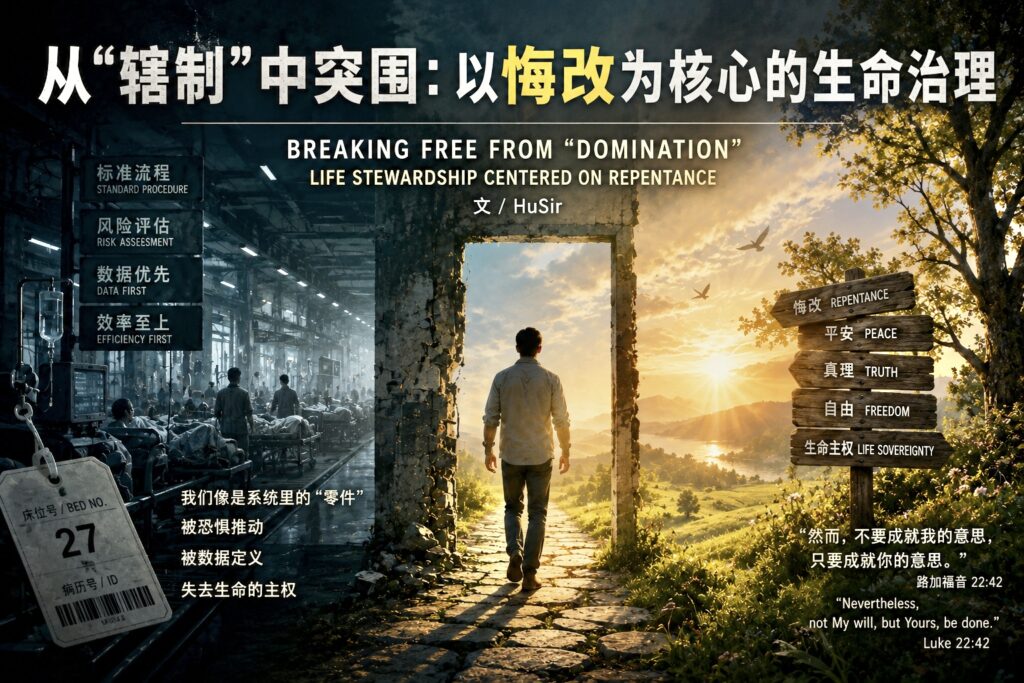
走进阴霾国的现代医院,很多人都会先经历停车困难,再经历人山人海的排队。开始治疗时,闻到的是消毒水冰冷的气味,看到的是如同流水线般精准而沉默的运作。人在这里,很容易被简化为床位号、化验单上的数据,以及CT影像里的阴影。
许多经历过重大疾病的弟兄姐妹都会有类似感受:当现代医疗体系进入高度专业化之后,人常常会在不知不觉中,被一步步推着向前走。各种治疗方案、风险评估、数据分析与“标准流程”,会不断告诉你下一步该做什么。即便身体已经极度疲惫,人依然很难停下来思考:我究竟是在“主动选择”,还是已经开始被一种巨大的系统逻辑推着前进?
这种如同求人办事一般的“被辖制感”,其实不仅存在于病房,也越来越广泛地存在于现代社会之中。
当权力、技术、资本与“专业权威”结合之后,人很容易在庞大的体系面前感到深层无力。我们像是巨大机器上的零件,被各种名为“科学”“标准”“安全”“效率”的逻辑不断推动。令人寒心的,有时不仅是疾病本身,更是人在体系面前逐渐失去生命主体性的那种无力感。
一:识破“辖制”的伪装
我们必须先问一个问题:为什么人如此容易被“辖制”?因为现代体系最擅长利用的,其实是人的恐惧。
例如,当人面对疾病时,内心最深的恐惧往往不是治疗本身,而是对死亡、失控与未知的恐惧。在这种状态下,人极容易将一切希望完全交托给外部权威,把技术、药物、数据与专家意见,当成唯一可靠的拯救。
于是,人慢慢开始相信:生命质量可以被指标取代;身体感受可以被数据覆盖;生存尊严也可以为“标准流程”让路。
而这种“辖制”,往往是隐形的。它并不会直接强迫你,而是通过恐惧、焦虑与“专业正确”的压力,让人逐渐失去独立判断能力。当一个信徒在专家意见与内心不安之间挣扎时,他真正面对的,其实是一场关于“谁才是生命之主”的挣扎。如果我们的平安完全建立在检测报告上,那么我们依然活在世俗逻辑的控制之下。
顺便说一下中医治疗,虽然有时候患者有幸找到适合的中医大夫,但绝大多数情况下,想寻觅到能全心全意为自己治病的大夫,机遇和难度都非常小。而且中医对患者治疗的要求不仅仅是吃药,还有一系列饮食起居的要求,真正想根除病证时,几乎需要一个人脱胎换骨才能实现,否则很难标本兼治,难度可想而知。
二:悔改——事关生命主权的回归
面对这种涉及身体健康的一系列辖制,圣经给出的道路,并不是逃避现实,而是“悔改”。
在很多人印象里,悔改只是流泪、自责,或对错误的承认。但圣经中的“悔改”(Metanoia),其实意味着一个人生命方向的转变——从顺从焦虑、恐惧、欲望与世界逻辑,转向顺从神的平安与真理。
这不仅仅是灵魂层面的改变,也会深刻影响人的身体与生活状态。认真面对信仰的人,会慢慢发现:许多长期的压抑、苦毒、不宽恕、对名利的执着,以及对死亡的持续恐惧,都会不断消耗人的生命状态。
人的身体并不是孤立存在的。情绪、精神与内心秩序,往往会真实影响身体,包括了从饮食到对五脏六腑运行环境的彻底改变。因此,悔改某种意义上也是一种“生命秩序的重建”。
当一个人开始从内心深处切断那些长期捆绑自己的恐惧、焦虑与执念;当一个人真正承认“生命最终在神手中”,而不只是完全交给冰冷的数据与系统逻辑时,他其实已经开始了从“辖制”中的突围。
三:构建心灵的“属灵抗体”
为什么真正活出这种自由如此困难?因为即便已是耶稣门徒的弟兄姐妹,他们当中的大多数也早已习惯做环境中的“被推动者”(美其名曰:适应环境,灵巧像蛇),却不习惯成为一个真正拥有内在自由的人。
而效法基督,恰恰意味着一种深层的属灵独立性。耶稣在客西马尼园面对死亡时,仍然能够说出:“然而,不要成就我的意思,只要成就你的意思。”(路22:42b)
这种对神的信靠,并不是软弱,反而让人拥有了一种不再轻易被恐惧控制的力量。当一个人不再被“必须活下来”的恐惧彻底吞没时,他才可能真正平静地思考:什么是真正必要的治疗;什么只是出于恐惧;什么是在维护生命;什么又是在过度消耗生命。
而这种内在状态,会真实影响人的身体。现代医学其实已经越来越承认:长期焦虑、恐惧、压抑与绝望,会持续削弱人的免疫系统;而平安、盼望与稳定的内心状态,则会帮助身体维持更健康的生命秩序。
因此,所谓“属灵抗体”,并不只是抽象宗教语言,而是一种真实的生命状态。当一个人借着悔改重新获得内心平安时,他就不再只是那个随波逐流、完全依赖系统安排的“零件”。他开始重新拥有:分辨能力;节制能力;面对死亡的勇气;以及对生命真正负责的能力。
结语:做自由的“活人”
曾有一位长期与疾病抗争的姐妹说过:“我们的盼望是永恒的,而不是世上暂时的光景。”这句话,其实正是一种属灵自由的体现。真正的信仰,并不是嘴上的安慰,而是在每一个生活选择、每一次恐惧来临、每一场疾病与压力之中,仍然愿意把生命重新带回神面前。身体是圣灵的殿。我们有责任珍惜它、治理它、守护它的尊严,而不是让它完全被焦虑、利益、恐惧与冰冷的系统逻辑所吞没。
最终的突围,并不是追求肉身永远不死,而是即便身处病痛与现实压力之中,人依然能够保有那份从神而来的真实、平安与自由。
愿我们都能从心灵深处,慢慢建立起那抵御恐惧、抵御冷漠、抵御绝望的“属灵抗体”,不再只是被环境推动的零件,而是真正在神面前自由、有灵、有生命的“活人”。
Breaking Free from “Domination”: Life Stewardship Centered on Repentance
By HuSir
Introduction: “Parts” Inside the System
Walking into a modern hospital in the Land of Shadows, many people first experience the difficulty of parking, followed by overwhelming crowds and endless lines. Once treatment begins, what greets you is the cold smell of disinfectant and the silent precision of an assembly-line system. In such a place, people are easily reduced to bed numbers, lab results, and shadows on CT scans.
Many brothers and sisters who have gone through serious illness share a similar feeling: once modern medicine becomes highly specialized, people are often pushed forward step by step without even realizing it. Treatment plans, risk assessments, data analysis, and “standard procedures” constantly tell you what the next step should be. Even when the body is utterly exhausted, it becomes difficult to stop and ask:
“Am I truly making my own choices, or am I already being carried forward by a massive system logic?”
This feeling of being “dominated,” almost like pleading with others for help, exists not only in hospitals but increasingly throughout modern society itself.
When power, technology, capital, and “professional authority” merge together, individuals easily experience a deep sense of helplessness before enormous systems. We become like parts inside a giant machine, constantly pushed forward by concepts called “science,” “standards,” “safety,” and “efficiency.” What chills the heart is sometimes not merely the illness itself, but the gradual loss of personal agency over one’s own life.
I. Recognizing the Disguise of “Domination”
We must first ask an important question:
Why are people so easily dominated?
Because modern systems are especially skilled at using fear.
When facing illness, a person’s deepest fear is often not the treatment itself, but the fear of death, loss of control, and uncertainty. In such a state, people easily hand over all hope to external authorities, treating technology, medication, data, and expert opinions as the only reliable salvation.
Slowly, people begin to believe that:
- quality of life can be replaced by numerical indicators;
- bodily experience can be overridden by data;
- and even human dignity can be sacrificed for the sake of “standard procedures.”
This kind of domination is often invisible.
It does not directly force people, but through fear, anxiety, and the pressure of “professional correctness,” it gradually strips away independent judgment. When a believer struggles between expert recommendations and inner unease, what they are truly facing is a deeper question:
Who is truly the Lord of life?
If our peace depends entirely upon medical reports and test results, then we are still living under the control of worldly logic.
A brief word should also be said about traditional Chinese medicine. Although some patients are fortunate enough to find a truly capable and caring practitioner, in most cases, finding a doctor fully devoted to healing the patient is extremely difficult. Moreover, traditional Chinese medicine often requires far more than simply taking herbs. It demands major changes in diet, daily habits, and ways of living. To truly address the root of illness, a person often needs an almost complete transformation of life itself. Otherwise, it becomes very difficult to treat both symptoms and root causes together.
II. Repentance — The Return of Life’s Stewardship
In the face of these forms of domination that deeply affect bodily health, Scripture does not point us toward escape, but toward repentance.
For many people, repentance simply means tears, guilt, or admitting mistakes.
But in Scripture, repentance (Metanoia) means a fundamental turning of one’s life direction — turning away from anxiety, fear, desire, and worldly logic, and turning toward the peace and truth of God.
This transformation affects not only the soul, but also profoundly influences the body and one’s entire state of life.
Those who sincerely take their faith seriously gradually discover that many long-term burdens — bitterness, unforgiveness, obsession with status and gain, and continual fear of death — constantly drain a person’s life force.
The human body does not exist in isolation. Emotions, spiritual conditions, and inner order genuinely affect the body, including everything from eating habits to the internal balance of the body’s organs and overall health environment.
In this sense, repentance is also a rebuilding of life’s order.
When a person begins to cut off the fears, anxieties, and obsessions that have long bound them from deep within; when a person truly acknowledges that life ultimately rests in God’s hands rather than entirely in cold data and system logic — that is the moment they begin to break free from domination.
III. Building Spiritual “Immunity”
Why is it so difficult to truly live out this freedom?
Because even among believers and followers of Christ, most people have long become accustomed to being “pushed along” by their environment (often calling it “adapting to reality” or being “wise as serpents”), while rarely learning how to become people with genuine inner freedom.
Yet following Christ means precisely this kind of deep spiritual independence.
When Jesus faced death in Gethsemane, He was still able to say:
“Nevertheless not My will, but Yours, be done.”
— Luke 22:42b (NKJV)
This trust in God was not weakness. On the contrary, it gave Him a strength no longer controlled by fear.
When a person is no longer completely consumed by the terror of “I must survive at all costs,” only then can they calmly begin to discern:
- What treatment is truly necessary;
- What choices are merely driven by fear;
- What genuinely preserves life;
- And what may actually be unnecessarily consuming it.
This inner condition genuinely affects the body.
Modern medicine itself increasingly acknowledges that prolonged anxiety, fear, repression, and despair continually weaken the immune system, while peace, hope, and emotional stability help sustain healthier bodily functions.
Thus, so-called “spiritual immunity” is not merely abstract religious language, but a very real state of life.
When a person regains inner peace through repentance, they no longer remain a passive “part” drifting with the system and depending entirely upon external arrangements.
Instead, they begin to regain:
- discernment;
- self-control;
- courage in the face of death;
- and the ability to truly take responsibility for life itself.
Conclusion: Becoming Truly “Alive”
A sister who struggled with illness for many years once said:
“Our hope is eternal, not in the temporary circumstances of this world.”
Those words themselves reveal a kind of spiritual freedom.
True faith is not merely verbal comfort. It means that in every life decision, every moment of fear, every illness, and every pressure of life, a person still chooses to bring their life back before God.
The body is the temple of the Holy Spirit. We are responsible for cherishing it, stewarding it, and protecting its dignity, rather than allowing it to be completely swallowed up by anxiety, profit, fear, and cold system logic.
Ultimately, true breakthrough is not the pursuit of physical immortality, but the ability to retain the authenticity, peace, and freedom that come from God even amid illness and worldly pressure.
May we all gradually build within ourselves that “spiritual immunity” which resists fear, coldness, and despair — so that we no longer remain mere parts pushed along by circumstances, but become truly living, spiritual, and free human beings before God.