文 / HuSir
在现实生活中,很多人都会说自己“有信仰”。有人信佛,有人信道,有人信基督,也有人口口声声强调自己“什么都不信”。但若进一步追问:“你所信的,究竟是什么?”很多人其实并没有认真思考过。
宗教、信仰与迷信,看似接近,实则完全不同。在现实生活中,很多人其实从未认真区分过它们。甚至将“有宗教”误以为“有信仰”,将“盲从”误以为“虔诚”。然而,一个人究竟是在追求真理,还是陷入迷信,其结果往往会决定他的人生方向。
什么是宗教?
宗教,本质上是一套关于世界、人性、善恶与终极意义的思想体系。它会形成教义、礼仪、组织与文化传统,并影响人的生活方式。佛教、道教、基督教、伊斯兰教等,都属于宗教。
但宗教本身,并不等于信仰。
一个人只是学习某种教义、参加某种仪式、拥有某种宗教身份,却没有真正让这些价值进入自己的生命,没有因此反思自己、改变自己、约束自己、活出更真实的人生,那么这更多只是“拥有一种宗教”,而不是真正拥有了信仰。尤其是摄于政权及其组织的威慑,不敢暴露自己的宗教信仰,不敢践行教义的指引,只在参加宗教场所的聚会时才敢公开自己的身份。
真正的信仰,往往意味着:一个人愿意按照自己所相信的真理去生活,愿意面对自身的问题,愿意悔改、成长,并在现实中努力活出爱、诚实、自由与责任。换句话说,信仰不是嘴里的“相信”,而是生命方向的改变。
因此,一个真正拥有信仰的人,不一定完美,却会越来越真实;不一定毫无软弱,却会越来越愿意面对自己的软弱。信仰的结果,不是把人变成机械化的“标准人格”,而是让人逐渐活出一个更自由、更完整的人。他愿意按照教义的指引,改变自己行事为人的方式,去面对生活和社会中出现的各种现象和问题,也不轻易被那些左右其心态和情绪的事情所吞没,因为他相信,自己所信靠的,最终值得信赖与依靠。
而迷信,则恰恰相反。迷信的核心,不是“相信”,而是“不假思索地服从”。迷信往往不允许人思考,也不鼓励人分辨。它要求人全盘接受,并默认其一切要求都天然正确。无论这些要求是否合理、是否伤害人性、是否令人失去自由,迷信者都不会认真反思。
因此,一个人即便口中高喊“信仰”,如果其结果是越来越恐惧、越来越封闭、越来越失去独立思考能力,那么他所进入的,很可能已经不是信仰,而是一种迷信。
更值得警惕的是,当宗教被政治力量深度改造之后,它往往会在不知不觉中变成另一种东西。
以基督教为例,基督信仰原本强调的是:人在上帝面前的平等、自由意志、爱与悔改,以及“真理使人得自由”的价值观。这些理念,实际上与许多现代普世价值观存在深层关联。然而,在阴霾国的宗教场所里,当宗教被强行加入政治因素、被要求优先服务于某种政治目标之后,许多原本关于真理与自由的内容,就会逐渐被替换、弱化,甚至被重新解释。那些不愿意公开接受这类政治化要求的家庭式教会,也逐渐成为被取缔的对象。
此时,人们所学习的,表面上是宗教,实际上却更像是某种政治纲领在宗教中的延伸。这种情况下,人实践的已不再是真正的宗教核心,而是一种被改变方向后的“变形宗教”。它看似仍保留着宗教的外壳,却已经越来越失去帮助人追求真理与自由的能力,并慢慢成为政治纲领在宗教生活中的一种具像化体现。
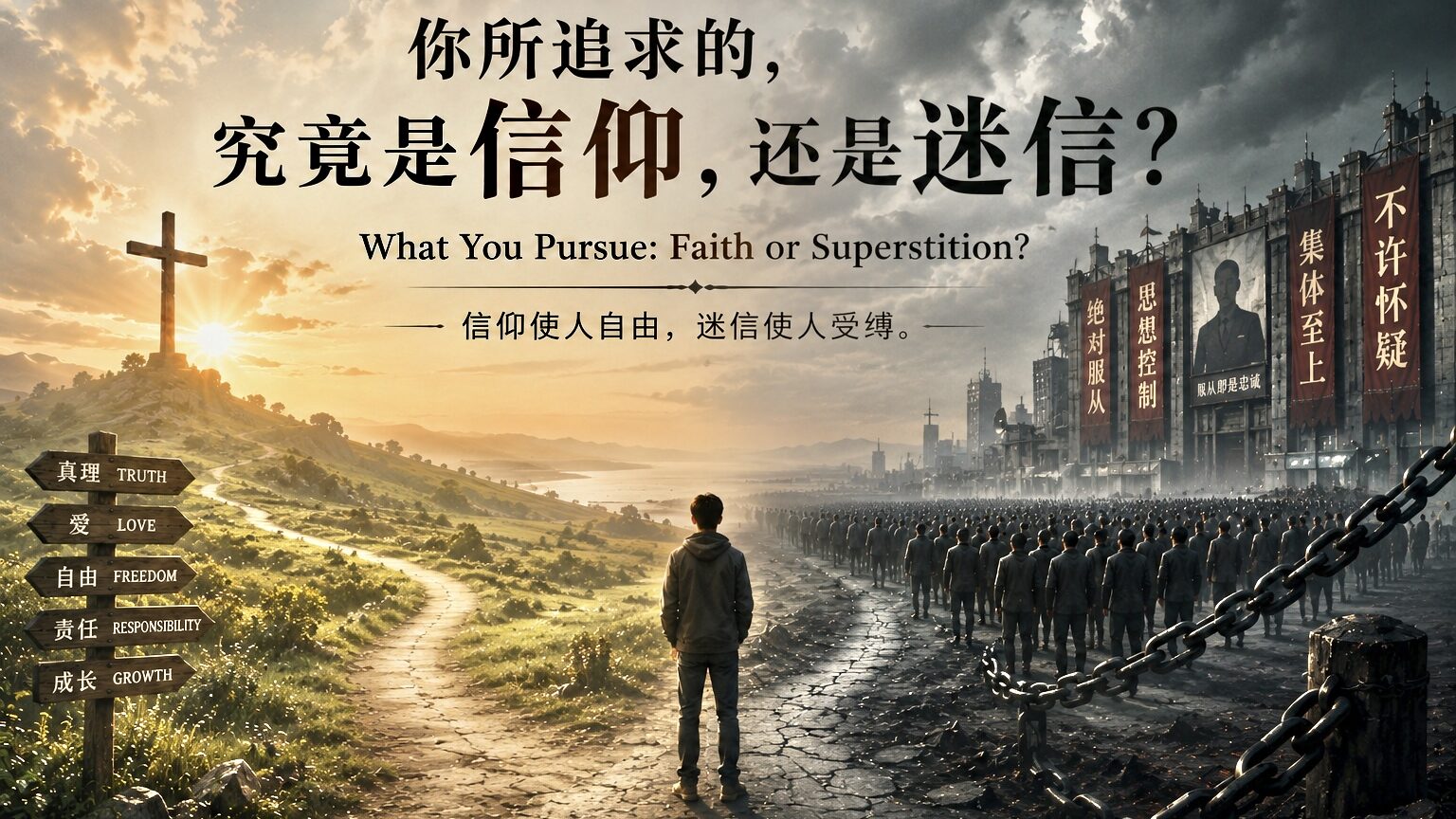
这种现象,并不仅仅存在于基督教之中。无论佛教、道教,甚至包括传统儒家思想,当其核心理念无法独立存在,而必须依附于政治结构时,其真正的精神空间都会被不断压缩。
最终,信众进入的,不再是通往自由与真理的道路,而是一种更加隐蔽的现实牢笼。
因此,一个人真正需要思考的问题,并不是“我属于哪个宗教”,而是:
我所信的,是否让我越来越真实?
是否让我更愿意面对自身的问题?
是否让我更懂得爱人与承担责任?
是否让我获得内心的自由,而不是更深的恐惧?
是否让我敢于思考,而不是失去思考?
因为真正的信仰,不会惧怕真理。
真正的信仰,也不会让人失去作为“人”的尊严与自由。
相反,它会让一个人,即便身处复杂现实之中,依然愿意不断修正自己,活出光明、诚实与爱。
而这,或许才是信仰与迷信之间,最根本的区别。
What Are You Truly pursuing, Faith or Superstition?
By HuSir
In everyday life, many people say they “have faith.” Some believe in Buddhism, some in Taoism, some in Christianity, while others repeatedly insist that they “believe in nothing.” But if we ask one more question—“What exactly is it that you believe in?”—many people have never seriously thought about it.
Religion, faith, and superstition may appear similar, but they are fundamentally different. In real life, many people never truly distinguish between them. Some mistake “having a religion” for “having faith,” while others mistake blind obedience for devotion. Yet whether a person is pursuing truth or falling into superstition will often determine the direction of that person’s life.
What is religion?
At its core, religion is a system of thought concerning the world, human nature, good and evil, and ultimate meaning. It forms doctrines, rituals, organizations, and cultural traditions, and influences the way people live. Buddhism, Taoism, Christianity, Islam, and others all belong to the category of religion.
But religion itself is not the same as faith.
A person may study certain doctrines, participate in rituals, or possess a religious identity, yet never truly allow those values to enter their life—never reflect upon themselves, change themselves, discipline themselves, or live more authentically because of them. In that case, they merely “have a religion,” rather than genuine faith. This is especially true when people, out of fear of political power and its organizations, dare not openly acknowledge their religious beliefs or practice the guidance of their doctrines, revealing their identity only when attending religious gatherings.
True faith often means that a person is willing to live according to the truth they believe in, willing to confront their own problems, willing to repent and grow, and willing to pursue love, honesty, freedom, and responsibility in real life. In other words, faith is not merely verbal belief; it is a transformation in the direction of one’s life.
Therefore, a person with genuine faith may not be perfect, but they become increasingly authentic; they may not be free of weakness, but they become increasingly willing to face their weaknesses. The result of faith is not to turn a person into a mechanical “standardized personality,” but to gradually shape them into someone more free and complete. Such a person is willing to follow the guidance of their beliefs, to change the way they conduct themselves, and to face the various realities and problems that arise in life and society. Nor are they easily consumed by things that disturb their emotions and mindset, because they believe that what they place their trust in is ultimately worthy of reliance and trust.
Superstition, however, is the exact opposite.
The essence of superstition is not belief, but unquestioning obedience. Superstition does not encourage thinking or discernment. It demands total acceptance and assumes that all its requirements are naturally correct. Whether those demands are reasonable, whether they damage human dignity, or whether they deprive people of freedom, the superstitious person rarely reflects seriously upon them.
Thus, even if someone loudly proclaims “faith,” if the result is increasing fear, increasing isolation, and an increasing loss of independent thinking, then what they have entered into is likely no longer faith, but superstition.
What is even more concerning is that when religion is deeply reshaped by political power, it gradually becomes something else entirely without people even realizing it.
Take Christianity as an example. The Christian faith originally emphasizes equality before God, free will, love and repentance, and the belief that “the truth shall set you free.” These ideas are deeply connected with many modern universal values. Yet within the religious institutions of the Shadow Nation, once religion is forcibly infused with political elements and required to prioritize certain political objectives, many teachings about truth and freedom gradually become replaced, weakened, or reinterpreted. House churches unwilling to publicly accept such politicized demands gradually become targets for suppression and elimination.
At that point, what people are learning may appear to be religion, but in reality it becomes more like an extension of political ideology within religion. Under such conditions, what people practice is no longer the true core of religion, but a distorted form whose direction has been altered. Though it still appears to retain a religious shell, it increasingly loses its ability to help people pursue truth and freedom, gradually becoming a concrete extension of political ideology within religious life itself.
This phenomenon does not exist only within Christianity. Whether in Buddhism, Taoism, or even traditional Confucian thought, once their core ideas can no longer exist independently and must instead attach themselves to political structures, their true spiritual space is continually compressed.
In the end, believers no longer enter a path toward freedom and truth, but rather a more hidden kind of worldly prison.
Therefore, the real question a person should ask is not, “Which religion do I belong to?” but rather:
Does what I believe make me more authentic?
Does it make me more willing to confront my own problems?
Does it teach me to love others and take responsibility?
Does it bring inner freedom rather than deeper fear?
Does it encourage me to think rather than lose the ability to think?
Because true faith does not fear truth.
True faith also does not strip a person of their dignity and freedom as a human being.
On the contrary, even in the midst of a complicated reality, it encourages a person to continually correct themselves and to live with light, honesty, and love.
And perhaps that is the most fundamental difference between faith and superstition.