——从宋江与李逵之间谈起
文 / HuSir
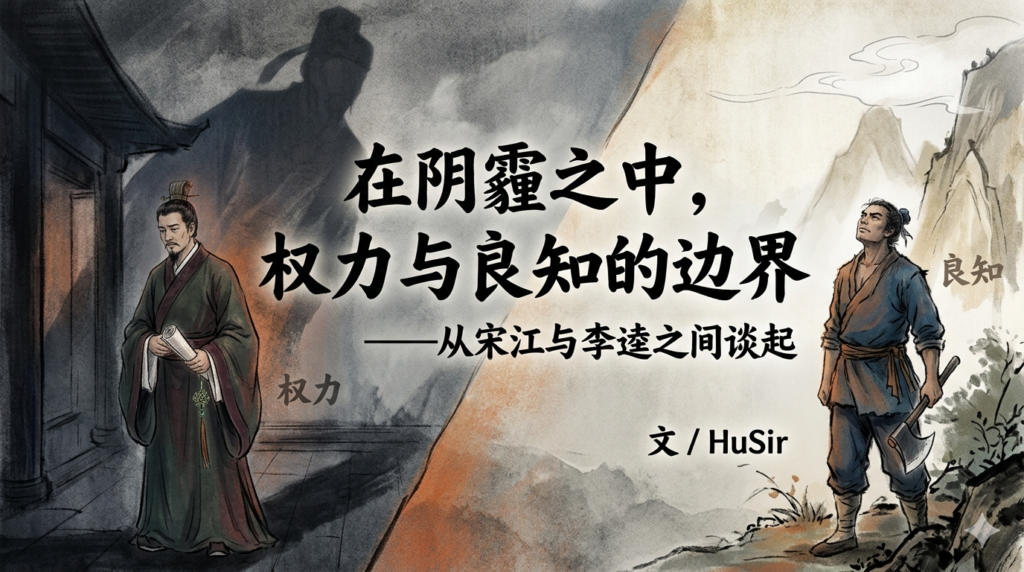
在古代阴霾国的《水浒传》中,宋江与李逵像是两种极端。一个选择归顺,在既有秩序之内寻找位置;一个本能反叛,对一切约束充满不信任。从结局来看,两者都带着某种悲剧色彩:宋江得到了名分,却失去了许多原本不愿失去的东西;李逵保留了本性,却无法在现实中真正安身。如果把这个故事放回现实,人们很容易发现,大多数人其实并不属于这两种极端。更多的人,是生活在结构之中的人。他们没有条件走向彻底的对抗,也不愿完全交出自己内心的判断。他们需要工作、需要家庭、需要在一个既有秩序中维持生活。
于是,一种更常见的状态出现了:在外部行为上选择顺从,在内心判断上尽量保留。这种状态很少被谈起,却广泛存在。有些人逐渐在这种状态中变得麻木,把顺从当成认同;也有一些人,依然清楚地知道某些事情的本来面目,只是选择在现实条件下,不去正面冲撞。他们知道某些说法并不真实,也知道某些行为并不合理,却仍然需要在既有结构中继续生活。这并不总是出于认同,很多时候是出于现实的约束。
但正是在这种约束之中,一个更重要的问题会慢慢浮现出来:当一个人不断在外部顺从时,是否也会在不知不觉中,把内心的判断一同交出去?这,或许才是真正的分界。一个人可以选择不对抗,也可以选择暂时沉默,甚至可以在某些场合配合既有的表达方式。但如果连“这是不真实的”这一点都不再清楚,或者不再愿意承认,那失去的就不只是立场,而是对真实的感知能力。
从这个意义上说,问题并不在于一个人是否像宋江,或是否像李逵,而在于:在结构之中,他是否还能保有属于自己的那一部分判断。有一些人,选择把那部分判断彻底放下,以换取更稳定的位置;也有一些人,虽然身处结构之中,却仍然在内心保留着一种界限。这种界限不一定表现为公开的反对,更多时候是一种内在的清醒。他们不会把错误当成正确,也不会因为重复的表达,而让自己逐渐相信那些原本就知道不真实的东西。
在现实条件允许的范围内,他们也许会用一些很微小的方式,去提醒他人、去表达不同的理解。这种方式不显眼,也不会带来立刻的改变,却可能在更长的时间里留下痕迹。在这些人当中,还有一部分人有着更坚定的内在依据。他们的判断并不完全建立在外部环境之上,而是来自一种更深的信念。这种信念使他们在面对现实压力时,不至于完全被同化。他们未必公开表达,却在具体的生活与关系中,用自己的方式去维持一种不同的尺度。这种存在很少被看见,但并不意味着它不存在。
回到宋江与李逵的故事,也许真正值得思考的,并不是谁更“正确”,而在于:在两者之间,是否还有第三种可能。这种可能,不在于改变整个结构,也不在于立刻做出极端选择,而在于,在有限的空间中,仍然保留对真实的判断,并在可能的范围内,不让这种判断完全消失。人不一定能选择所处的结构,但可以选择在其中是否完全失去良知。这种选择往往没有声音,也没有掌声,却可能决定一个人最终成为怎样的人。
如果从信仰的角度来看,这个问题还有另一层更深的含义。在现实结构之中,一个人之所以能够顺服某些外在秩序,并不只是因为环境的压力,也可能源于他内心所承认的更高权柄。
当一个人心中没有更高的参照时,他对现实权力的顺从,很容易转变为依附,甚至不自觉地把外在的权威当成最终的标准。在这样的情况下,人不仅在行为上受限制,也会在内心逐渐被同化,失去真正的自由。
而对于有基督信仰的人来说,顺服并不等同于认同。他可以在现实之中承担角色、遵守秩序,但他内心所归属的,并不是某一个具体的权力结构,而是一个更高的存在。正因为如此,他在面对不真实或不公义时,仍然能够保持一种内在的界限。这种界限,并不一定表现为外在的对抗,而是一种清醒的分辨:知道什么是暂时的安排,什么才是最终的标准。
也正是在这种分辨之中,人不至于被环境完全吞没。因此,问题或许并不只是“是否顺服”,而在于:在顺服之中,一个人是否仍然知道自己真正所归属的对象是谁。如果没有这一点,顺服就可能变成一种被动的接受;而当内心有了更高的指向,顺服反而可能成为一种有界限的选择。真正决定人是否被奴役的,不是他所处的结构,而是他内心最终服从的对象。
Between Power and Conscience in the Gloom:
—–A Discussion Starting from Song Jiang and Li Kui
By HuSir
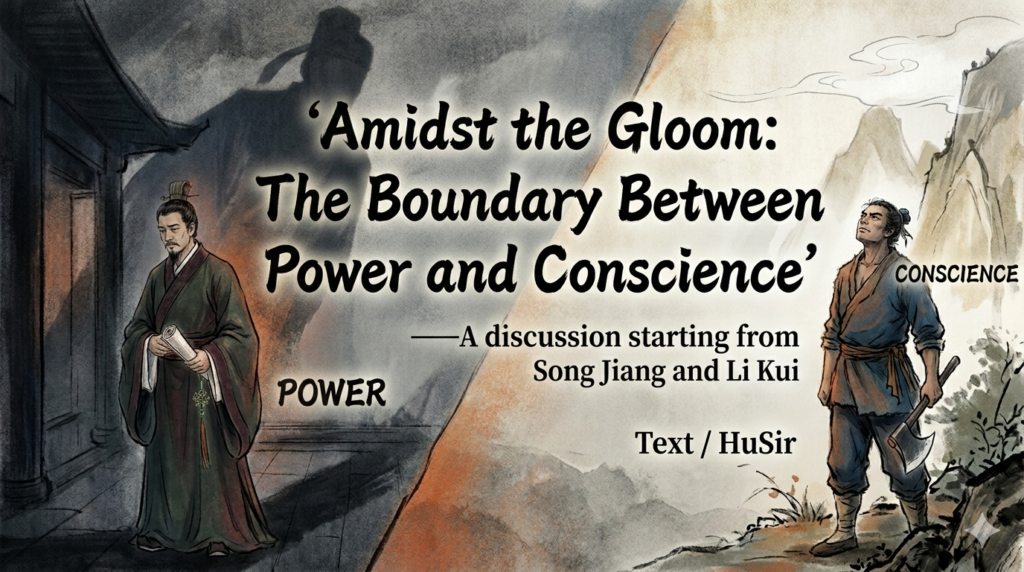
In the classic “Country of Gloom,” Water Margin, Song Jiang and Li Kui represent two extremes. One chooses to submit, seeking a position within the existing order; the other rebels by instinct, harboring a profound distrust of all constraints. Judging by their endings, both are tinged with tragedy: Song Jiang gained a title but lost much of what he was once unwilling to forfeit; Li Kui preserved his original nature but found no place to truly settle in reality. When this story is applied to the real world, it becomes evident that most people do not belong to either of these extremes. Rather, most are “people within the structure.” They lack the conditions for total confrontation, yet they are unwilling to completely surrender their inner judgment. They need jobs, families, and a way to maintain a life within a pre-existing order.
Consequently, a more common state emerges: choosing compliance in external behavior while attempting to retain inner judgment. This state is rarely discussed, yet it is widespread. Some gradually grow numb in this condition, mistaking compliance for endorsement; others remain clearly aware of the true nature of things, simply choosing not to clash head-on under their current circumstances. They know certain narratives are untrue and certain actions are unreasonable, yet they must continue to live within the established structure. This is not always born of agreement; often, it is born of practical constraint.
However, it is precisely within these constraints that a more significant question surfaces: when a person repeatedly complies externally, do they unknowingly surrender their inner judgment as well? This, perhaps, is the true dividing line. One may choose not to resist, to remain temporarily silent, or even to cooperate with established modes of expression on certain occasions. But if one is no longer clear—or no longer willing to admit—that “this is untrue,” then what is lost is not just a stance, but the very capacity to perceive reality.
In this sense, the issue is not whether one is like Song Jiang or Li Kui, but rather: within the structure, can one still maintain a judgment of their own? Some choose to cast that judgment aside entirely in exchange for a more stable position; others, though embedded in the structure, still maintain an internal boundary. This boundary does not necessarily manifest as public opposition; more often, it is an internal sobriety. They do not mistake wrong for right, nor do they allow themselves to gradually believe things they know to be false simply because those things are repeatedly expressed.
Within the limits of what reality allows, they might use very subtle ways to remind others or express a different understanding. These methods are inconspicuous and bring no immediate change, yet they may leave traces over a longer span of time. Among these individuals, some possess an even firmer internal foundation. Their judgment is not built entirely upon the external environment but stems from a deeper conviction. This conviction prevents them from being completely assimilated when facing social pressure. They may not express it openly, but in their concrete lives and relationships, they use their own ways to maintain a different yardstick. This existence is rarely seen, but that does not mean it does not exist.
Returning to the story of Song Jiang and Li Kui, perhaps what is truly worth contemplating is not who was more “correct,” but whether there is a third possibility between them. This possibility lies not in changing the entire structure, nor in immediately making an extreme choice, but in retaining a judgment of the truth within limited spaces and, to the extent possible, not letting that judgment vanish entirely. One may not be able to choose the structure they inhabit, but they can choose whether to lose their conscience within it. This choice often has no voice and receives no applause, yet it may ultimately determine what kind of person one becomes.
From the perspective of faith, this question carries an even deeper layer of meaning. Within a social structure, the reason a person can submit to certain external orders is not just due to environmental pressure, but may also stem from the higher authority they acknowledge in their heart.
When a person has no higher reference point in their soul, their submission to worldly power easily turns into dependency, leading them to unconsciously treat external authority as the ultimate standard. In such a case, the person is not only restricted in action but is also gradually assimilated internally, losing true freedom.
For those with Christian faith, however, submission is not equivalent to endorsement. One can fulfill roles and obey orders within reality, but their inner belonging is not to any specific power structure, but to a higher existence. Because of this, when facing the untruthful or the unjust, they are still able to maintain an internal boundary. This boundary does not necessarily manifest as external confrontation, but as a sober discernment: knowing what is a temporary arrangement and what is the ultimate standard.
It is precisely through this discernment that one avoids being completely swallowed by their environment. Therefore, the question may not simply be “whether to submit,” but rather: in the midst of submission, does a person still know to whom they truly belong? Without this, submission may become a passive acceptance; but when the heart has a higher orientation, submission can instead become a choice with boundaries. What truly determines whether a person is enslaved is not the structure they are in, but the object of their heart’s ultimate obedience.