文/HuSir
不知道从什么时候开始,我发现自己越来越容易被一些与自己毫无关系的视频感动。
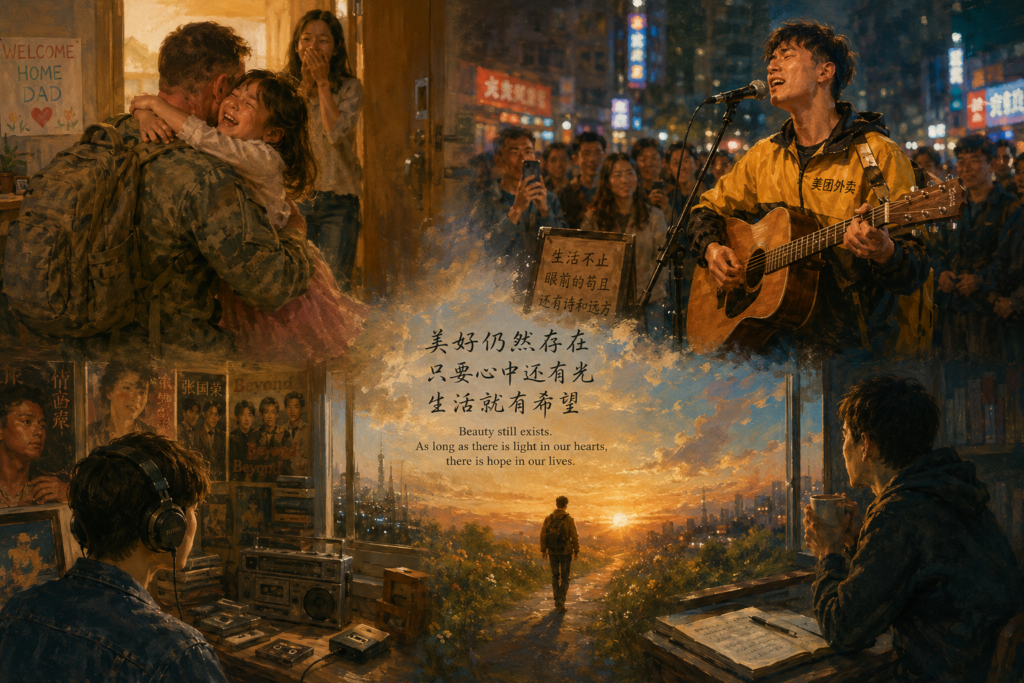
有时是一位长期驻外的军人,悄悄回到家中,没有告诉妻子和孩子。当房门打开,孩子先是愣在那里,几秒钟后才认出眼前的人,随即哭着扑进父亲怀里。镜头晃动着,屋里的人笑着流泪,而屏幕这一边的我,也忍不住湿了眼眶。有时是一位穿着外卖制服的年轻人,结束了一天奔波,随手接过街头的话筒,却唱出一首让所有人安静下来的歌曲。那个每天穿梭在城市里的普通劳动者,原来还有如此动人的歌喉。还有那些熟悉的八十年代港台歌曲,在年轻人的重新演绎下,再一次响起,仿佛把人带回那个充满理想和希望的年代。
这些人与我毫无关系。我不认识他们,也从未经历过他们的人生。然而,每一次看到这样的画面,我都会觉得自己仿佛也站在人群之中,与他们一起分享着那份快乐和幸福。
后来我开始思考,我们为什么会为陌生人的幸福感动?也许,真正让我们流泪的,并不是那个故事本身,而是故事里所呈现的人性。军人回家,让我们看见了团聚;外卖员歌唱,让我们看见了梦想没有因为生活而消失;一首老歌,让我们重新听见了青春、爱情和那个曾经相信未来会越来越好的自己。这些画面都有一个共同点:它们告诉我们,人并不仅仅是为了活着。
现代社会常常把人生解释成竞争、收入、职位、房子和各种数字。久而久之,我们也渐渐相信,一个人的价值就是他拥有多少、获得多少、超过别人多少。然而,那些真正让我们热泪盈眶的瞬间,却几乎都与这些没有关系。
一个拥抱,一次重逢,一首歌曲,一份坚持,一个普通人的才华,一个孩子发自内心的笑容,它们没有财富的光环,没有权力的装饰,却足以击中人的内心。我想,这说明人的生命深处,一直保留着一种辨认美好的能力。
更有意思的是,看完这些视频之后,手机放下,生活并不会因此发生什么改变。我还是那个普通人,没有军人的荣耀,没有歌手的舞台,也没有值得别人拍摄和传播的传奇故事。我依旧要面对平凡的工作、柴米油盐和每天重复的生活。可是,每一次这样的感动,却都会在心里留下一个小小的火种。它让我觉得,即使自己默默无闻,也没有必要把生命活成一潭死水;即使没有耀眼的成就,也仍然可以认真学习一样新的东西,写好一篇文章,关心一个需要帮助的人,或者坚持完成自己一直想完成的梦想。原来,幸福并不一定属于自己,才能给自己带来力量。别人的幸福,也能够照亮我们的生命。
这些年,我们生活在一个充满焦虑和冲突的时代。网络每天都在推送各种愤怒、对立、谩骂和冲突,仿佛世界只剩下矛盾与敌意。再看看现实中的不公,看看那些依靠权力压迫别人、依靠谎言维持秩序的人,难免让人觉得灰心,甚至怀疑善良还有没有意义。可是,每当我再次看见那些普通人的笑容,看见孩子扑向父亲的怀抱,看见一位外卖员在人群中唱出自己的梦想,看见一首老歌仍然能够让几代人一起轻轻合唱,我又会觉得,那些令人失望的社会现象,其实并没有真正赢。这些令人失望的人和组织,一次次用他们的权威让我们一度觉得生活不再有希望和前途。
因为,它们可以制造恐惧,却制造不了爱。可以制造沉默,却制造不了歌声。它们可以制造服从,却制造不了真诚。它们能够限制人的身体,却很难彻底囚禁人的心灵。
我越来越相信,上帝创造人的时候,并没有只是赋予人求生的本能。祂也把对美的感受、对自由的向往、对亲情的依恋、对善良的渴望放进了人的心里。正因为如此,一个陌生人的幸福,才会让另一个陌生人流泪;一个普通人的坚持,才会让无数普通人重新燃起希望。《传道书》说:“神造万物,各按其时成为美好,又将永生安置在世人心里。”(传道书3:11a)
也许,我们真正感动的,并不是某一个具体的人,而是透过他们,看见了神起初创造世界时那份本来应该属于人的美好。所以,每当我被这些画面感动的时候,我都会感谢这种感动。因为它提醒我,我的心还没有麻木。
我仍然会为一个拥抱落泪,仍然会为一首老歌停留,仍然会为陌生人的幸福微笑。这说明,在现实的压力和岁月的磨砺之下,我心里仍然保留着一块没有被黑暗侵蚀的地方。实际上,每个人心里都有这样一片沃土。而只要那里还有光,我就愿意继续努力,继续学习,继续写作,继续相信善良,相信自由,相信爱,也相信神赐给人的生命,本来就值得这样认真地活下去。
或许,我们终究只是无数普通人中的一个。但一个能够为陌生人的幸福而感动的人,也一定能够在自己的生命里,慢慢成为别人幸福的一部分,成为别人生命里的一束光。
Why Are We Moved by the Happiness of Strangers?
By HuSir
At some point, I realized that I had become increasingly moved by videos that had absolutely nothing to do with me.
Sometimes it is a soldier returning home after a long deployment without telling his wife or children. As the door opens, his child stands there in confusion for a few seconds before suddenly recognizing him, bursting into tears, and throwing himself into his father’s arms. The camera shakes as everyone in the room laughs through their tears. Sitting on the other side of the screen, I often find my own eyes filling with tears as well. Other times, it is a food delivery worker who, after a long day of rushing through the city, casually takes a microphone on a street corner and begins singing with a voice so beautiful that the entire crowd falls silent. Behind the ordinary uniform is a remarkable talent. Then there are the classic Cantonese and Taiwanese songs of the 1980s, sung once again by a younger generation, transporting us back to an era filled with hope, ideals, and dreams for the future.
These people are complete strangers to me. I have never met them, nor have I lived their lives. Yet every time I witness scenes like these, I feel as though I am standing among them, sharing in their joy and happiness.
Eventually, I began asking myself: Why are we moved by the happiness of strangers? Perhaps what brings tears to our eyes is not the story itself, but the humanity revealed through it. A soldier returning home reminds us of reunion. A delivery worker singing reminds us that dreams do not necessarily disappear beneath the weight of daily life. An old song awakens memories of youth, love, and the version of ourselves that once believed tomorrow would always be brighter. These moments all have one thing in common: they remind us that human beings were not created merely to survive.
Modern society often measures life in terms of competition, income, status, houses, and countless numbers. Over time, we begin to believe that a person’s worth depends on how much they possess, how much they achieve, or how far they surpass others. Yet the moments that move us most deeply have almost nothing to do with any of these things.
A hug. A reunion. A song. A quiet act of perseverance. The hidden talent of an ordinary person. The genuine smile of a child. None of these carries the glamour of wealth or the decoration of power, yet each possesses the extraordinary ability to reach the deepest part of the human heart. I believe this reveals something profound: deep within us remains an innate ability to recognize what is truly beautiful.
What is even more interesting is that after watching these videos, we put down our phones, and nothing in our own lives has outwardly changed. I am still an ordinary man, without a soldier’s honor, a singer’s stage, or a life dramatic enough to become someone else’s story. I still return to ordinary work, daily responsibilities, and the endless routines of life. Yet every one of these moments leaves behind a small spark within me. They remind me that even if I remain unknown, I do not have to allow my life to become stagnant. Even without remarkable achievements, I can still learn something new, write another meaningful article, care for someone in need, or continue pursuing dreams that have long lived in my heart. I have come to realize that happiness does not have to belong to us personally in order to give us strength. The happiness of others can illuminate our own lives as well.
In recent years, we have lived in an age filled with anxiety and conflict. Every day, the internet delivers an endless stream of anger, division, insults, and confrontation, making it seem as though the world contains nothing but hostility. Then we look at injustice around us. We see people who rely on power to oppress others and those who sustain authority through deception. It is easy to become discouraged and begin wondering whether goodness still has any meaning. Yet whenever I see ordinary people smiling again, whenever I watch a child running into a father’s embrace, a delivery worker singing with all his heart, or generations quietly singing along to an old song, I realize that these disappointing realities have never truly won. Again and again, certain people and institutions use their authority to make us believe that life no longer holds hope or a future.
They can create fear, but they cannot create love. They can create silence, but they cannot create songs. They can demand obedience, but they cannot produce sincerity. They may restrict the human body, but they can never completely imprison the human soul.
I have become increasingly convinced that when God created humanity, He did not simply give us the instinct to survive. He also placed within us a longing for beauty, freedom, family, kindness, and truth. That is why the happiness of one stranger can bring another stranger to tears. That is why the perseverance of one ordinary person can rekindle hope in countless others. As Ecclesiastes says, “He has made everything beautiful in its time. Also He has put eternity in their hearts,” (Ecclesiastes 3:11a NKJV)
Perhaps what truly moves us is not any particular individual, but what we glimpse through them—the beauty that belonged to humanity when God first created the world. That is why, whenever these moments move me, I am grateful for the feeling itself. It reminds me that my heart has not yet grown numb.
I can still be moved by an embrace. I can still pause for an old song. I can still smile at the happiness of strangers. That tells me that beneath all the pressures of life and the wear of passing years, there remains within me a place that darkness has not conquered. In truth, every human heart contains such fertile ground. And as long as there is still light within it, I want to keep striving, keep learning, keep writing, keep believing in goodness, freedom, and love, and keep believing that the life God has given us is worthy of being lived with sincerity and purpose.
Perhaps, in the end, we are all just ordinary people among billions of others. But anyone who can be genuinely moved by the happiness of strangers can, in time, become part of someone else’s happiness—and perhaps even become a light in another person’s life.
发表回复