
文 / HuSir
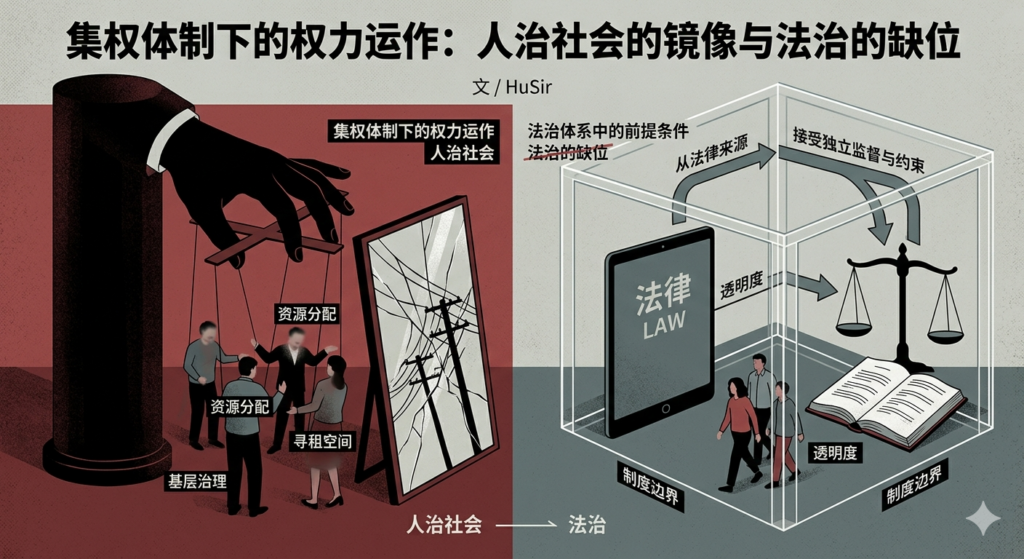
在一些高度集权的体制环境中,人们往往会在不同层级的公共运作中,反复看到类似的现象:权力在具体执行过程中,出现偏离公共目标的情况。这种现象,并不总是以显性的“大案要案”形式出现,更多时候,是以一种分散而日常的方式,存在于基层治理、公共资源分配以及服务执行的各个环节之中。从中央到地方,从行政体系到基层公共服务领域,都可以观察到权力在实际运行中被不断放大与再分配,而与之相伴的,则是不同程度的寻租空间与灰色操作。因此,问题或许并不只是个别行为,而更可能与制度结构本身有关。
一、从高层级到底层:权力运作的扩散逻辑
集权体制的一个显著特征,是权力在结构上的高度集中,以及在运行过程中的层层传导。在这样的体系中,上层决策往往拥有较大的裁量空间,而在向下执行的过程中,这种裁量权也会以不同形式被分解、转移,并在具体环节中形成新的权力节点。基层治理因此成为一个关键观察点。在涉及土地、项目、补贴、公共资源分配等领域,具体执行者往往拥有较大的实际操作空间,而外部监督则相对有限。在这种条件下,权力与资源之间的交换关系,更容易在日常操作中逐渐固化。即便是在一些看似技术性或服务性的公共岗位中,这种逻辑也可能以更隐蔽的方式存在。因此,人们所感受到的,并不只是“个别腐败”,而是一种贯穿不同层级的权力运作方式。
二、从现象到结构:为什么问题反复出现
在这样的环境中,反腐行动往往以“整治”或“清理”的形式周期性出现。这些行动在短期内可以产生一定效果,但如果缺乏制度层面的持续约束,问题往往会在不同阶段、不同层级中反复出现。原因并不完全在于个体道德,而在于权力运行的基本逻辑。当权力缺乏独立外部制衡时,其运行边界往往更多依赖于内部约束与上级监督。这种约束方式,本身具有不稳定性,也容易受到人事变化与环境调整的影响。因此,问题更像是一种结构性现象,而非偶发性的偏差。
三、人治与法治:两种不同的运行逻辑
如果从更抽象的层面来看,这种现象可以放在“人治”与“法治”的框架下理解。在以人治为主导的环境中,权力往往先于规则而存在。法律在实践中,更多体现为执行工具,其适用范围与力度,可能随着具体情境发生变化。而在真正的法治体系中,法律则构成权力运作的前提条件。权力必须来源于法律,并在法律框架内运行,同时接受独立机制的持续监督与约束。两者的区别,并不只是制度设计上的差异,更体现在实际运行的稳定性与可预期性上。在缺乏外部制衡的情况下,权力更容易形成自我循环的结构,而腐败,则可能成为这种结构中的“副产品”。
四、关于出路:从治理方式到制度约束
如果问题主要源于结构,那么解决路径也不应仅停留在个体层面。提高透明度、强化独立监督、完善制度边界,这些都属于更长期的调整方向。相较于阶段性的整治行动,制度化的约束机制,更可能在时间维度上产生持续效果。这并不是对某一具体环境的简单批评,而是一种基于经验与比较的观察。
结语
从日常经验出发,人们往往更容易感受到的是具体的不公与不透明;而从结构角度来看,这些现象之间,往往存在某种内在关联。如果说有一个可以作为判断标准的原则,那或许可以简单表述为:真正稳定的社会运行,并不依赖于个别人的克制,而在于一种更清晰的边界——人和政党,需要服从法律,而不是权力。
Power Dynamics Under Centralized Systems: A Mirror of Personalist Societies and the Absence of Rule of Law
By HuSir
In certain highly centralized institutional environments, one often observes a recurring phenomenon across various levels of public operation: the deviation of power from public goals during its concrete execution. This phenomenon does not always manifest as high-profile “major legal cases.” More often, it exists in a dispersed and everyday manner within primary-level governance, the allocation of public resources, and the execution of public services. From the central to the local levels, and from the administrative hierarchy to the grassroots of public service, one can observe power being continuously amplified and redistributed during its practical operation. Accompanying this process are varying degrees of rent-seeking opportunities and “grey” maneuvers. Consequently, the issue may not merely involve individual conduct but is likely rooted in the institutional structure itself.
I. From Hierarchy to Detail: The Diffusion Logic of Power Operations
A prominent feature of a centralized system is the high concentration of power within the structure and its layer-by-layer transmission during operation. In such a system, high-level decision-makers often possess significant discretionary space. As decisions are executed downward, this discretion is decomposed and transferred in various forms, creating new “nodes of power” at specific levels. Primary-level governance thus becomes a critical point of observation. In fields involving land, projects, subsidies, and the allocation of public resources, the specific executors often have substantial practical leeway, while external oversight remains relatively limited. Under these conditions, the exchange between power and resources tends to solidify through daily operations. Even in public roles that appear technical or service-oriented, this logic can exist in more hidden forms. Therefore, what people experience is not just “isolated corruption,” but a mode of power operation that permeates different levels of the hierarchy.
II. From Phenomenon to Structure: Why Problems Recur
In such environments, anti-corruption efforts often appear periodically in the form of “rectification” or “cleanup” campaigns. While these actions can yield results in the short term, the problems tend to resurface at different stages and levels if there is a lack of sustained institutional constraint. The cause lies not entirely in individual morality but in the fundamental logic of how power operates. When power lacks independent external checks and balances, its boundaries rely more on internal discipline and superior oversight. This form of constraint is inherently unstable and easily influenced by personnel changes or environmental adjustments. Consequently, the problem resembles a structural phenomenon rather than an accidental deviation.
III. Rule of Man vs. Rule of Law: Two Different Operational Logics
From a more abstract perspective, this phenomenon can be understood within the framework of “Rule of Man” versus “Rule of Law.” In an environment dominated by the Rule of Man, power often precedes rules. In practice, the law functions more as an enforcement tool, and its scope and intensity of application may shift depending on the specific context. Conversely, in a true system of Rule of Law, the law constitutes the prerequisite for the operation of power. Power must originate from the law and operate within its framework, while remaining subject to continuous oversight and constraint by independent mechanisms. The difference between the two lies not just in institutional design, but in the stability and predictability of actual operations. In the absence of external checks, power more easily forms a self-circulating structure, within which corruption can become a structural “by-product.”
IV. The Way Forward: From Governance Methods to Institutional Constraints
If the problem is primarily structural, the solution should not remain confined to the individual level. Increasing transparency, strengthening independent oversight, and refining institutional boundaries are all directions for long-term adjustment. Compared to periodic rectification campaigns, institutionalized constraint mechanisms are more likely to produce sustained effects over time. This is not a simple critique of any specific environment, but an observation based on experience and comparative analysis.
Conclusion
Starting from daily experience, people are more likely to perceive specific instances of injustice and opacity. However, from a structural viewpoint, there is often an inherent connection between these phenomena. If there were a principle to serve as a criterion for judgment, it might be simply expressed as follows: The truly stable operation of a society does not depend on the self-restraint of specific individuals, but on a clearer boundary—where people and political parties must submit to the law, rather than to power.