文/HuSir
在这个万物皆可量化的时代,我们经常被两种截然不同的叙事包裹着:一种是宏大叙事里的“幸福感”,仿佛幸福是某种自上而下、按需分配的礼物;另一种则是每个普通人内心的真实体感——在算法的缝隙中突围,在固化的阶层前徘徊。
我们不禁要问:一个国家的人民生活得幸福与否,究竟取决于谁?而我们,又究竟该对谁心存感恩?
幸福的“所有权”:谁在供养谁?
长期以来,一种隐形的逻辑试图说服我们:我们的安稳生活、脚下的路、眼前的光,皆是某种权力的“赐予”。在这种逻辑下,幸福被异化为一种“德政”,而民众则成了被动的领受者。然而,这恰恰颠倒了现代社会最基本的契约关系。
事实上,所有的繁荣都不来自施舍,而是来自数亿个体为了改善命运而迸发出的原始本能。是清晨五点的环卫工人,是写字楼里透支健康的白领,是那些在重压之下依然维持社会运转的纳税人。是人民在供养系统,而非系统在施舍人民。幸福不是从天而降的甘露,而是每一个奔向生计的脚步声汇聚而成的合奏。
被“锁死”的生存空间:算法与利益的合围
但现实的残酷之处在于,这种自下而上的奋斗正面临前所未有的挤压。
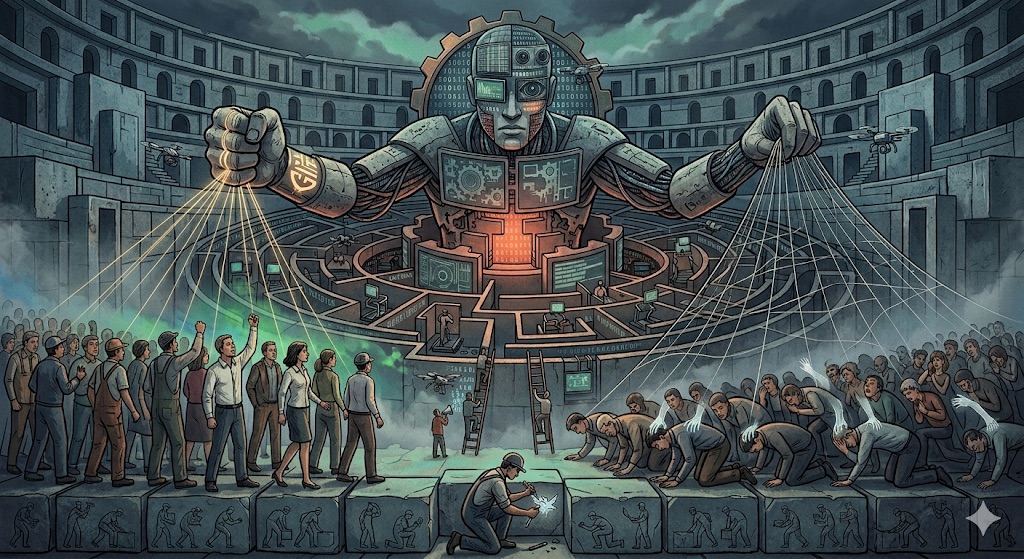
当大数据算法精准地扫描每一个个体的价值,并将其归类、标签化时,生存空间被“锁死”了。算法不仅在优化效率,更在后台设定了普通人努力的上限——它计算出你精力的极限,并将其设为考核的标准。更令人无奈的是,既得利益团体的惯性与制度设计的滞后交织成网,使得公平竞争不再是天经地义的权利。
在这样的环境下,机会成了一种稀缺的特权。除非你“非常优秀”,优秀到足以让系统为你破例,否则普通人很难在密不透风的规则中获得一点微小的公平。这种“超额内卷”不仅是对个人精力的浪费,更是对社会创造力的系统性磨损。
表达的尊严:没有自由,何来幸福?
如果说公平竞争决定了物质的获取,那么表达的自由则决定了人的尊严。
幸福感不仅仅是胃里的饱腹感,更是心理上的归属感与安全感。一个健康的社会需要反馈机制。当一个人能够自由地指出不公、表达诉求时,他才是一个“主体”,而非一个“工具”。如果表达的空间被压缩,所有的幸福感都会带上一种虚假的人造感。毕竟,如果一个人连痛苦都不能喊出来,那么他的“快乐”又有多少含金量?
幸福感的延伸含义则是,你是否有额外的精力为社会贡献财富和劳动,甚至做义工的时间和行动力。如果一个人只能为了生计疲于奔命,连自身的体能恢复都算是奢侈品、连讲出自己的不公待遇都是枉然,那他所做的一切只能是叫生存,而不是生活,更谈不上自由的生活。换句话说,这个人只是高楼大厦最底下的奠基石,永远看不到大厦上层的旖旎风光。
拒绝“情感税”:重新定义感恩
在这样的语境中,最吊诡的现象莫过于:一种本应由心而发的“感激”,却常常变成了一种自上而下的“要求”。
我们被要求去感激那个为我们维持秩序、提供基础设施的宏大意志。然而,这种“被要求的感激”,本质上是一种权力的傲慢。当政府履行其应尽的公共服务职责时,那叫履约,不叫施舍。要求一个在算法中疲于奔命、在阶层固化中挣扎求生、在表达受限时沉默不语的普通人去“心存感恩”,这无异于是在收取了高额的生存成本后,又强行征收了一道心理层面的“情感税”。不仅如此,政府甚至可以剥夺你是否可以在所属城市“骑摩托车”,是否可以让孩子“自由选择学校”,甚至是否可以“自由出行”。种种限制,不可胜数。
这种感激逻辑消解了我们的权利意识。如果幸福是“被赐予”的,那么当这种赐予变得吝啬,当不公降临时,我们似乎连质疑的资格都失去了。
结语:找回真实的坐标
那么,我们该对谁心存感恩?
我们应当感恩同类——那些在同样艰辛环境下守望相助、坚持底线的普通人;我们应当感恩先驱——那些为了争取公平、法治和表达自由而付出代价的人;我们更应当感恩自己——感恩在压力、算法和不公面前,依然没有选择麻木、依然在追求卓越的那个自己。
一个成熟的社会,不需要战战兢兢的感激,而需要理直气壮的监督。因为幸福从来不是谁的恩赐——它仅是权利的产物,幸福是自由的呼吸,更是每一个劳动者挺直腰板换来的尊严。
Whose Happiness, Whose Grace? — Reflections on Survival in the Age of Big Data
By HuSir
In this era where everything can be quantified, we are often enveloped by two diametrically opposed narratives. One is the “sense of happiness” found in grand narratives, where happiness is portrayed as a gift bestowed from above, distributed according to some plan. The other is the lived reality of the ordinary individual—struggling through the cracks of algorithms and hovering before the walls of entrenched social strata.
We must ask: Does the happiness of a nation’s people truly depend on who is in power? And to whom, ultimately, do we owe our gratitude?
The “Ownership” of Happiness: Who Is Sustaining Whom?
For a long time, an invisible logic has sought to convince us that our stable lives, the roads beneath our feet, and the light before our eyes are all “grants” from authority. Under this logic, happiness is alienated into a form of “benevolent governance,” and the people are reduced to passive recipients. However, this completely inverts the most fundamental social contract of a modern society.
In reality, all prosperity stems not from charity, but from the primal instinct of hundreds of millions of individuals striving to improve their own destinies. It is the sanitation worker at five in the morning; it is the white-collar worker in an office building sacrificing their health; it is the taxpayer who sustains the operation of society under immense pressure. It is the people who “add brick and mortar” to the system, not the system that bestows charity upon the people. Happiness is not manna falling from the heavens; it is a symphony composed of the footsteps of every soul rushing toward their livelihood.
A “Locked” Space for Survival: The Siege of Algorithms and Interests
The cruel reality, however, is that this bottom-up struggle is facing unprecedented suppression.
When Big Data algorithms precisely scan the value of every individual—categorizing and labeling them—the space for survival becomes “locked.” Algorithms do not merely optimize efficiency; they set a silent ceiling on the efforts of ordinary people, calculating the absolute limits of human energy and turning those limits into a standardized benchmark. More frustratingly, the inertia of vested interest groups and the lag in institutional design weave a net that ensures fair competition is no longer a natural right.
In such an environment, opportunity becomes a scarce privilege. Unless you are “extraordinarily excellent”—excellent enough to force the system to make an exception for you—it is difficult for an ordinary person to find even a sliver of fairness within these airtight rules. This “excessive involution” (neijuan) is not just a waste of individual energy; it is a systematic erosion of social creativity.
The Dignity of Expression: Without Freedom, Where Is Happiness?
If fair competition determines the acquisition of material wealth, then the freedom of expression determines the dignity of being human.
Happiness is more than just a full stomach; it is a psychological sense of belonging and security. A healthy society requires a feedback mechanism. Only when an individual can freely point out injustice and express their demands do they become a “subject” rather than a “tool.” If the space for expression is compressed, all sense of happiness takes on a hollow, manufactured quality. After all, if a person cannot even cry out in pain, how much value can their “joy” possibly hold?
An extension of happiness is whether one has the surplus energy to contribute wealth and labor to society, or even the time and agency to volunteer. If a person is forced to exhaust themselves just to subsist—where physical recovery is a luxury and speaking out about unfair treatment is futile—then what they do is called “survival,” not “living,” let alone a life of freedom. In other words, such a person is merely a foundation stone at the very bottom of a skyscraper, destined never to see the breathtaking scenery of the upper floors.
Rejecting the “Emotion Tax”: Redefining Gratitude
In this context, the most absurd phenomenon is how “gratitude,” which should spring from the heart, is often transformed into a “requirement” imposed from above.
We are told to be grateful to the grand will that maintains order and provides infrastructure. Yet, this “demanded gratitude” is essentially the arrogance of power. When a government fulfills its duty to provide public services, it is fulfilling a contract, not granting a favor. To demand that an ordinary person—exhausted by algorithms, struggling in a rigid hierarchy, and silenced by restrictions—feel “heartfelt gratitude” is akin to taking a high price for survival and then forcibly collecting a psychological “emotion tax” on the way out. Furthermore, those in power can restrict whether you may “ride a motorcycle” in your own city, whether you can “freely choose a school” for your child, or even whether you can “travel freely.” Such examples are too numerous to count.
This logic of gratitude erodes our consciousness of our own rights. If happiness is “bestowed,” then when that bestowal becomes stingy or when injustice falls upon us, we seem to lose even the standing to question it.
Conclusion: Reclaiming the True Coordinates
To whom, then, should we be grateful?
We should be grateful to our peers—those ordinary people who support one another and maintain their integrity in equally difficult circumstances. We should be grateful to the pioneers—those who paid a price to strive for fairness, the rule of law, and the freedom of expression. And most of all, we should be grateful to ourselves—for not choosing numbness in the face of pressure, algorithms, and injustice, and for continuing to pursue excellence.
A mature society does not need trembling gratitude; it needs principled oversight. For happiness is never anyone’s grace—it is the product of rights, the breath of freedom, and the dignity earned by every laborer standing tall.