文 / HuSir
摘要
当一个体制越来越依靠“控制”而不是“回应人民需求”来维持稳定,它真正面临的风险并不来自外部敌人,而是来自自身结构的空洞与腐朽。本文以《1984》的隐喻,分析权力如何通过恐惧、谎言与操控逐渐失去现实感知能力,并最终走向自我瓦解。
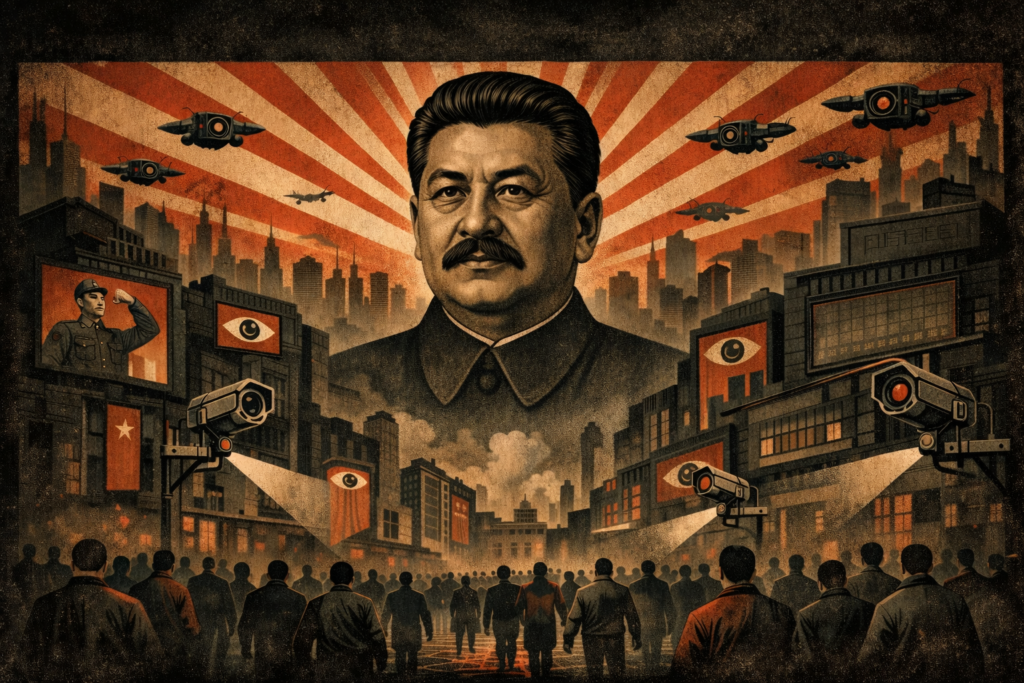
在英社(IngSoc,是乔治·奥威尔反乌托邦小说《1984》中大洋国的执政党,全称“英格兰社会主义”)的永恒光芒下,老大哥的眼睛永不眨动,全神贯注地盯着他的百姓。他注视着每一条街道,每一间屋子,每一个屏幕后的灵魂。在大洋国,这个被重命名为“和谐社”的广阔领土,已然成为老大哥心目中的完美镜像。
老大哥的党——哦,是的,我们的党——早已不再费心倾听人民的低语。它不需要。它只需挥舞铁拳,确保每一声叹息都被改写为赞美之歌。任何能让百姓高兴的聚集他都要让人驱散,哪怕是百姓之间作为生命本能的娱乐与情感表达,也要被严加管控。控制,便是稳定;回应百姓生存需求?那不过是旧时代的幻影,一种被双重思想抹去的谬误。这样的管控如同温水煮青蛙,逐年加码,变本加厉,将百姓的生存、言论、自由等空间压缩殆尽。
然而,对老大哥而言,在这永不落幕的监视剧场中,真正的风险并非来自外部敌人,那些被贴上“西方颠覆者”标签的幽灵。风险潜伏在内部,如同真理部档案室里永不熄灭的焚烧炉,吞噬着一切真实。
党的控制不断升级。伟大的防火墙如新语般过滤思想;社会信用系统像思想警察般评分忠诚;摄像头如老大哥的千万只眼睛,记录每一次不经意的皱眉。普通人的生活因此悄然改变:谈话变得简短而谨慎,玩笑变得稀有而危险,梦想被压缩为可通过审查的格式,未来被重写成宣传中的模板。
人民的需求被重塑为党的需求。饥饿转为节俭的美德,不满转为对敌人的仇恨,创新转为对党的颂扬,恐惧转为“安全感”。
长期来看,这真正的风险,正潜伏在党的核心——权力本身。内党成员躲在他们的空调堡垒中,沉溺于操纵现实的双重游戏。他们不断修改历史,操控媒体,清洗异见,以为这样便可永世不朽。然而他们彼此之间也开始失去信任:每一条命令都伴随怀疑,每一次忠诚都需要验证,每一次晋升都暗含背叛。他们逐渐发现,自己得到的已不是真实信息,而是被层层过滤后的谎言。制度开始对自己失明。
而人民呢?他们表面顺从,口中吟诵口号,心底却积聚着无声的疲惫与冷漠。百姓虽然逐渐看清了老大哥的真正目的和嘴脸,内心也无数次酝酿过反抗,但却无法形成合力。经济开始停滞,因为在排斥外来自由世界的交流与援助之下,计划经济压制了民间创新与发展;青年一代的热情被制度性犬儒吞噬;底层民众的贫困被宏大叙事覆盖成“历史必然”。
革命不会发生——党已学会如何提前扑灭一切火种。崩塌将以另一种方式到来:通过缓慢、寂静、无人宣告的腐朽。资源逐渐枯竭,盟友悄然疏离,内部派系在无声中互相绞杀,系统越来越重,却越来越空。最终,人民不会起义。他们只会停止相信,连老大哥的党员自身也开始感受到生存空间的持续收缩,并由此对政策的合理性产生怀疑。
当双重思想的枷锁开始松动,当恐惧不再能解释一切,真理将不以英雄之姿降临,而以现实之重压垮整个结构。党将倒下——不是因为外部的轰炸,而是因为它自己的虚空:一个建基于谎言之上的稳定沙堡。
同志们,请看透老大哥的策略:战争即和平,自由即奴役,无知即力量。这三句话分别代表持续制造外部威胁,让社会在恐惧中“团结”,实则掩盖内部矛盾;将盲目服从包装为“免于思考的幸福”,让人放弃权利却误以为获得解脱;剥夺知识与真相,使人无力质疑,从而巩固控制者的权力。本质是通过扭曲语言与逻辑,消灭个人思想,让统治永久化。
但在和谐社的深处,当控制取代回应,真正的风险,正是这个党自身的灭亡。
老大哥仍在微笑。
但他无法永生。
What Risks Arise When “Stability Through Control” Ignores the Needs of the People?
By HuSir
Short Abstract
When a system relies on control rather than responding to the real needs of its people, its greatest risk does not come from external enemies but from its own hollow core. Through the metaphor of 1984, this essay explores how power, sustained by fear and falsehood, gradually loses touch with reality and ultimately collapses from within.
Under the eternal light of IngSoc (the ruling Party of Oceania in George Orwell’s 1984, short for “English Socialism”), Big Brother’s eyes never blink. They gaze intently upon the people — every street, every home, every soul behind every screen. In Oceania, now renamed the “Harmonious Society,” the nation has become the perfect reflection of Big Brother’s ideal vision.
Big Brother’s Party — yes, our Party — no longer bothers to listen to the people’s quiet voices. It does not need to. All it must do is wield the iron fist and ensure that every sigh is rewritten as a hymn of praise. Any gathering that brings people joy must be dispersed; even the most basic human expressions of emotion and pleasure are placed under strict control. Control, after all, is stability. Responding to the people’s real needs? That is merely an illusion of a bygone age — a fallacy erased by doublethink. This tightening grip resembles the boiling of a frog in warm water: year after year, the pressure increases, gradually compressing every space of survival, speech, and freedom.
Yet for Big Brother, the greatest danger in this endless theater of surveillance does not come from external enemies — those ghosts branded as “Western subversives.” The true danger lurks within, like the ever-burning furnace of the Ministry of Truth, consuming reality itself.
Control continues to escalate. The Great Firewall filters thought like Newspeak. The social credit system scores loyalty like the Thought Police. Cameras become millions of Big Brother’s eyes, recording even the slightest unguarded frown. Ordinary life quietly changes: conversations grow shorter and more cautious; humor becomes rare and dangerous; dreams are compressed into approved formats; the future is rewritten into propaganda templates.
The people’s needs are reshaped into the Party’s needs. Hunger becomes a virtue of frugality. Discontent is redirected into hatred of enemies. Innovation becomes praise for the Party. Fear becomes “a sense of security.”
In the long run, the real risk lies at the core of the Party itself — power. Inner Party members hide in their air-conditioned fortresses, intoxicated by their double game of manipulating reality. They rewrite history, control the media, and purge dissent, believing this will grant them eternal rule. Yet they increasingly distrust one another: every order is laced with suspicion, every loyalty test hides betrayal, every promotion carries danger. They gradually discover that the information they receive is no longer real — only lies filtered through countless layers. The system becomes blind to itself.
And the people? Outwardly obedient, chanting slogans, inwardly accumulating silent exhaustion and numbness. Though many have come to recognize Big Brother’s true face and intentions, their countless inner rebellions never coalesce. The economy begins to stagnate, as innovation is smothered by a planned system that isolates itself from the free world. The passion of the younger generation is swallowed by institutional cynicism. The poverty of the lower classes is buried beneath grand narratives of “historical necessity.”
Revolution will not come — the Party has learned how to extinguish every spark in advance. Collapse will arrive differently: slowly, silently, without announcement. Resources are depleted. Allies drift away. Factions within the Party quietly destroy one another. The system grows heavier yet emptier. In the end, the people will not rise up — they will simply stop believing. Even Party members begin to feel their own shrinking space for survival and quietly question the rationality of the system.
When the chains of doublethink begin to loosen, when fear can no longer explain everything, truth will not appear as a heroic savior but as the unbearable weight of reality. The Party will fall — not by external bombardment, but by its own hollow core: a castle of stability built upon lies.
Comrades, see clearly Big Brother’s strategy:
War is Peace. Freedom is Slavery. Ignorance is Strength.
These three slogans mean:
manufacture perpetual external threats to force “unity” while concealing internal collapse;
package blind obedience as “freedom from thinking,” persuading people to surrender rights while believing they gain happiness;
strip away knowledge and truth so no one can question power — ensuring permanent control.
The essence is the destruction of individual thought through the corruption of language and logic.
But deep within the Harmonious Society, when control replaces responsiveness, the greatest risk is the Party’s own demise.
Big Brother still smiles.
But he cannot live forever.