——兼论本土资源的“目标升级”之路
文/HuSir
引言:为何我们总在“得过且过”中轮回?
自古以来,阴霾国人的反抗往往是被动的。只要苛捐杂税尚能忍受,只要生存底线未被彻底踏破,民众便倾向于在现有的权力框架下寻求妥协。这种“苟全性命”的哲学,源于我们长期缺乏对普世价值观(如天赋人权、自由、法治)的系统性追求。
本文并非宣称阴霾国人天生拥有完整宪政基因,而是试图揭示:这些基因的雏形早已深埋在本土传统之中,只是长期被血缘局限、出世倾向与外部枷锁所束缚。要实现宪政,我们需要将宗祠的自治精神与佛教的平等理念,从“家族私情”或“个人解脱”提升到“普世公民契约”与“公共权利维护”的高度。这一步跨越,既非全盘西化,也非简单复古,而是一场艰难却真实的“文明归家”运动。
一、宗祠文化:被局限在“部族”内的自治雏形
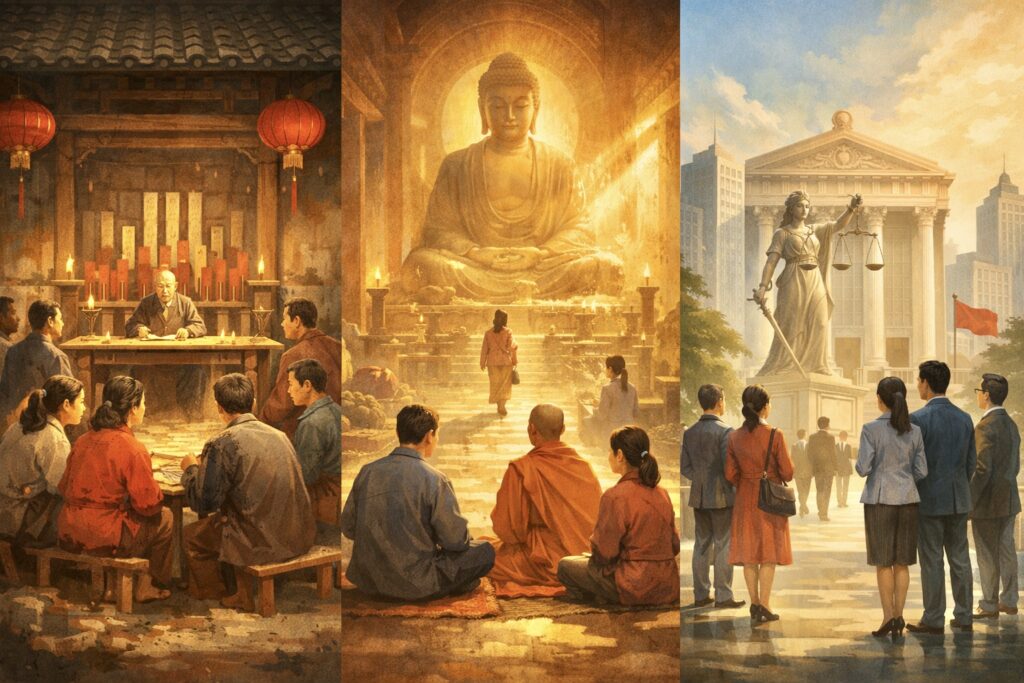
宗祠文化是阴霾国人延续两千年的基层治理母体,尤其在明清时期的华南、江南、赣南、闽西等地区,形成了较为成熟的民间自治空间。它在功能上确实接近宪政逻辑的某些要素,但因其强烈的血缘性与等级性,力量始终碎片化,无法自然演进为现代公民社会。
需要指出的是,这种自治更多是一种“局部治理经验”,而非现代意义上的公民制度,但它提供了可转化的社会基础。
- 权力制衡的雏形:历史上“皇权不下县”的说法虽被当代学者(如秦晖)指出存在地域局限和理想化成分,但宗祠确实在许多乡村创造了国家权力难以完全渗透的自治缓冲带。这本质上是民间自发的“防御性分权”——族长、长老、公议共同约束权力,接近有限政府的萌芽。
- 法治原型:《家训》与《族规》构成家族内部的“准宪法”。它确立了“法在族长之上”的朴素认知,甚至包含对族产、继承、救济的权利保护机制。
- 关键短板与跨越路径:传统宗祠本质上是“血缘共同体内部的等级治理”(父系、房分、长幼、男女尊卑),它能有效保护“族人”却难以跨越血缘界限。历史上宗族之间械斗、霸田、资源垄断屡见不鲜,往往需要国家或士绅出面调停。这一步的跨越,在于将“爱吾族人”升华为“爱吾公民”——把宗祠的自治精神从血缘纽带转化为跨血缘的公民契约组织。一旦突破血缘局限,宪政的基层组织基础便能真正稳固。
当代可借鉴路径:部分地区已出现“宗族联谊会”“祠堂公益基金会”转型,将族产用于乡村教育、环保、互助,逐步向现代公民社团演化。
二、佛教教义:被误读为“消极避世”的平等权利论
佛教为阴霾国人提供了精神世界里最彻底的平等逻辑,是对抗世俗等级制度最强有力的思想资源。但需明确:佛教的平等首先是本体论平等(形而上),而非直接的制度平等。
需要区分的是,佛教提供的是价值基础,而非直接的制度设计。
· 佛性平等:“众生皆有佛性”是东方版的人格尊严宣言。它宣告:在终极真理面前,皇帝与乞丐并无高下之分。这与西方“天赋人权”在逻辑起点上高度契合。
· 因果程序:佛教的因果律是一种超越个人意志的“宇宙法治”,它内化了“行为即责任”的契约意识,成为法治精神在东方的深层心理积淀。
· 关键短板与跨越路径:历史上阴霾国佛教主流是“出世间”导向,常被用于个人避难、消灾祈福或与皇权共生(僧官制度、度牒控制),极少直接转化为积极的政治权利斗争。真正实现“此岸化”的转折,始于近代太虚法师等倡导的人间佛教运动。
这一步的跨越,是将“证悟佛性”与“维护世俗权利”紧密挂钩。只有当我们意识到“维护他人的自由就是维护因果的公义”时,佛教的慈悲才能转化为宪政民主中的“公民勇气”与“公共担当”。当代人间佛教团体(如台湾慈济、一些大陆公益寺院)参与环保、扶贫、权益倡导,已初步展现这种转化潜力。
三、历史的重锁:三重枷锁而非单一断裂
阴霾国人宪政基因未能自然发育,并非单一外来主义之过,而是遭遇了层层叠加的结构性阻碍:
· 两千年皇权辖持:皇权以“法家手段、儒家外壳”不断分化宗祠,将其窄化为伦理教化工具而非独立自治实体。只要民众还能“得过且过”,便缺乏界定权力边界的动力。
· 近代现代化冲击:清末太平天国、洋务运动、科举废除、新文化运动以及20世纪上半叶的城市化、商业化,已严重瓦解宗族的经济基础与社会凝聚力。国民党时期的“党化基层”与“新生活运动”进一步加速了传统自治的衰落。
· 高度集中的全能国家接管:20世纪引入的高度集中化国家,借助现代组织技术,显著削弱了民间原有的自治结构。它拆毁宗祠、没收族产、行政化寺庙,将阴霾国人从“敬天法祖”的自治民,变成了“依附权力”的原子化个体。
三重锁链叠加,才形成了今日“记忆被辖持”的阵痛。这记忆来自深藏于人民生活中、深藏于人民的精神追求中、深藏于人民对自由人生的渴求中,需要的是着眼于普世价值的第一步。
四、结论:提升目标,跨出那“关键的一步”
阴霾国人离宪政、民主生活其实只有一步之遥。这一步不是浪漫复古,也不是一夜觉醒,而是一场需要几代人持续努力的“目标升级”:
· 从“反抗暴政”到“追求权利”:我们的抗争不能仅仅因为“活不下去”,而应是因为“我们的公民权利被侵犯”。
· 从“守护宗祠”到“守护宪法”:意识到宪法就是保护所有家族、所有祠堂、所有私产的“总族规”。
· 从“个人觉悟”到“公共自由”:没有公共的自由,个人的涅槃与安宁便如流沙上的建筑。
这条路充满荆棘。日本明治维新能较成功转化传统资源(武士道、神道、儒学),得益于外部压力、精英共识与地缘条件;而阴霾国因幅员辽阔、历史惯性与现代化节奏不同,难度更大。但正因如此,“本土资源+目标升级”的路径才更具持久生命力。
制度的关键,不在于形式来自何处,而在于它是否真正保护普通人的权利与尊严。
号召:
当下阴霾国人正处于“记忆被辖持”的阵痛中。需要的是我们重新点燃对祖先祭礼的契约尊重、重新激活佛性平等的公共担当,走向宪政民主就不再是“西化”,而是一场波澜壮阔的“文明归家运动”。那些已经以基督作为个人和家庭救主的民众,需要的是用宪政民主思想思考日常生活的差异,以耶稣基督的带领面对社会生活。
意识形态的红墙看似高耸,但它基座之下,是两千年未曾断绝的自治血脉。一旦民众将“普世价值”作为生命追求而非苟全手段,那一步跨出之时,便是宪政花开之日。
给读者的核心建议
· 重新审视家史:挖掘宗族文献中关于自治、公议、权利保护的真实记忆,而非仅停留在祭祖情感。
· 重新解读信仰:拥护“人间佛教”的积极面向,将个人证悟转化为公共勇气。
· 确立权利红线:不再以“得过且过”为荣,而以“捍卫权利”为日常实践——从小事(如社区公益、家族基金透明化)开始,逐步积累公民习惯。
· 行动起点:尝试建立或参与跨血缘的“现代宗亲公益组织”或“人间佛教权益倡导团体”,让传统资源在21世纪真正“活”起来。
本文不是鼓励反抗“苛捐杂税”式的统治,而是提醒人们反思阴霾国2000多年的被治理历史,争取“还政于民”的生活。
One Step Away: Reinterpreting Constitutionalism and Democracy through Ancestral Halls and Buddhism
— On the “Goal Upgrade” Path of Indigenous Resources
By HuSir
Introduction: Why Do We Remain Trapped in “Getting By”?
Throughout history, resistance among people in “the Veiled Land” has often been passive. As long as taxes and burdens remain tolerable, and as long as the basic threshold of survival is not entirely broken, people tend to seek compromise within the existing framework of power. This philosophy of “preserving one’s life at all costs” stems from a long-standing lack of systematic pursuit of universal values such as natural rights, freedom, and the rule of law.
This article does not claim that the people inherently possess a fully developed constitutional gene. Rather, it seeks to reveal that the rudiments of such a gene have long been embedded within indigenous traditions, yet constrained by kinship boundaries, otherworldly orientations, and external institutional constraints. To achieve constitutionalism, we must elevate the spirit of autonomy found in ancestral halls and the egalitarian principles of Buddhism—from “family-based affection” or “individual liberation” to the level of “universal civic contracts” and “public rights protection.” This step is neither wholesale Westernization nor simple restoration of tradition, but a difficult yet genuine movement of “civilizational homecoming.”
I. Ancestral Hall Culture: A Prototype of Self-Governance Confined within Kinship
Ancestral hall culture has served as the foundational unit of grassroots governance for over two thousand years, particularly in regions such as South China, Jiangnan, southern Jiangxi, and western Fujian during the Ming and Qing dynasties. It developed relatively mature forms of local self-governance. Functionally, it indeed resembles certain elements of constitutional logic. However, due to its strong kinship orientation and hierarchical nature, its influence remained fragmented and could not naturally evolve into a modern civil society.
It should be noted that such governance represents more of a “localized governance experience” rather than a modern civic system, yet it provides a social foundation that can be transformed.
- A rudimentary form of power balancing: Although the saying “imperial power does not extend below the county level” has been critiqued by modern scholars (such as Qin Hui) as regionally limited and somewhat idealized, ancestral halls did, in many rural areas, create a buffer zone where state power could not fully penetrate. This essentially constituted a form of grassroots “defensive decentralization”—clan leaders, elders, and collective deliberation jointly constrained authority, approximating an early form of limited government.
- A prototype of rule of law: Clan rules and family instructions functioned as a “quasi-constitution” within the lineage. They established a rudimentary understanding that “rules stand above the clan leader,” and even included mechanisms for protecting rights related to property, inheritance, and relief.
- Key limitations and the path of transition: Traditional ancestral halls were essentially systems of hierarchical governance within kinship communities (patrilineal structures, generational order, gender hierarchy). While effective in protecting “members of the clan,” they could not transcend kinship boundaries. Historical records show frequent conflicts between clans over land and resources, often requiring intervention by the state or local elites. The key transition lies in elevating “care for one’s clan” into “care for fellow citizens”—transforming kinship-based governance into civic contractual organizations that transcend blood ties. Once this boundary is crossed, the grassroots foundation for constitutionalism can become truly stable.
Contemporary pathways can already be observed: in some regions, clan associations and ancestral hall foundations are evolving, using collective assets for education, environmental protection, and mutual aid—gradually transforming into modern civic organizations.
II. Buddhist Thought: An Egalitarian Doctrine Misinterpreted as Passive Withdrawal
Buddhism provides one of the most profound frameworks of equality within the spiritual world and stands as one of the strongest intellectual resources against worldly hierarchies. However, it must be clarified that Buddhist equality is primarily ontological (metaphysical), rather than directly institutional.
It is important to distinguish that Buddhism offers a value foundation, rather than a direct blueprint for institutional design.
- Equality of Buddha-nature: The teaching that “all sentient beings possess Buddha-nature” is, in essence, an Eastern declaration of human dignity. It proclaims that before ultimate truth, there is no fundamental difference between emperor and beggar. This aligns closely with the Western concept of natural rights at the level of philosophical origin.
- Causality as procedural logic: The Buddhist law of karma functions as a form of “cosmic rule of law” that transcends individual will. It internalizes the principle that “actions entail responsibility,” forming a deep psychological foundation for legal consciousness in Eastern societies.
- Key limitations and the path of transition: Historically, mainstream Buddhism in this context leaned toward a “transcendent” orientation—often used for personal refuge, ritual merit-making, or coexisting with imperial authority (through systems such as monastic administration and ordination control). It rarely translated directly into active engagement with political rights. The turning point toward “this-world engagement” began with modern movements such as Humanistic Buddhism advocated by figures like Master Taixu.
The essential transition lies in linking “awakening to Buddha-nature” with “defending worldly rights.” Only when we recognize that protecting others’ freedom is itself an expression of karmic justice can Buddhist compassion be transformed into civic courage and public responsibility within constitutional democracy. Contemporary Humanistic Buddhist organizations (such as Tzu Chi in Taiwan and some public welfare temples in mainland regions) have begun to demonstrate this potential through environmental, poverty alleviation, and advocacy work.
III. Historical Constraints: A Triple Lock Rather than a Single Break
The failure of constitutional development in this context cannot be attributed to a single external ideology, but rather to layered structural constraints:
- Two thousand years of imperial dominance: Imperial authority continuously fragmented and reshaped ancestral halls using “Legalist methods with Confucian packaging,” reducing them to instruments of moral discipline rather than independent governance entities. As long as people could still “get by,” there was little motivation to define the boundaries of power.
- Modernizing disruptions: Late Qing upheavals, the Taiping Rebellion, the Self-Strengthening Movement, the abolition of the imperial examination system, and the New Culture Movement, along with early 20th-century urbanization and commercialization, severely weakened the economic and social cohesion of clan structures. During the Republican era, political mobilization and social reform campaigns further accelerated this decline.
- The rise of a centralized modern state: The introduction of a highly centralized political system in the 20th century, combined with modern organizational techniques, significantly weakened traditional grassroots autonomy. Ancestral halls were dismantled, clan assets confiscated, and religious institutions administratively absorbed, transforming a society once rooted in reverence for ancestors into one of atomized individuals dependent on centralized authority.
The combination of these three layers forms the present condition—a form of “controlled memory.” Yet this memory persists: in daily life, in spiritual longings, and in the enduring desire for freedom. The question is how to take the first step toward universal values.
IV. Conclusion: Upgrading the Goal—Taking the Crucial Step
The distance to constitutional democracy is, in a sense, only one step. But this step is neither romantic nostalgia nor sudden awakening. It is a generational process of “goal upgrading”:
- From resisting oppression to pursuing rights
Resistance should not arise merely from survival pressure, but from the recognition that civic rights are being violated. - From protecting ancestral halls to protecting the constitution
Understanding that the constitution functions as the “supreme clan code” that safeguards all families, properties, and communities. - From personal enlightenment to public freedom
Without public freedom, individual peace or spiritual realization remains unstable—like a structure built on shifting sand.
This path is difficult. Japan’s Meiji Restoration succeeded in transforming traditional resources due to external pressure, elite consensus, and favorable conditions. By contrast, the scale, historical inertia, and developmental trajectory here make the challenge far greater. Yet precisely for this reason, the path of “indigenous resources + goal upgrading” holds deeper and more enduring vitality.
The essence of any system does not lie in where its form originates, but in whether it truly protects the rights and dignity of ordinary people.
A Call to Action
Today, people are experiencing the pain of “constrained memory.” What is needed is to rekindle the contractual respect embedded in ancestral traditions, and to reactivate the public responsibility inherent in the concept of universal Buddha-nature. In doing so, constitutional democracy will no longer appear as “Westernization,” but as a profound movement of civilizational homecoming.
For those who have embraced Christ as their personal and family Savior, the next step is to interpret daily life through the lens of constitutional thought, and to face society under the guidance of Jesus Christ.
Though the walls of ideological systems may appear towering, beneath them lies a two-thousand-year legacy of self-governance. Once people begin to pursue universal values as a life commitment rather than a survival strategy, that single step forward will mark the blooming of constitutionalism.
Core Suggestions for Readers
- Reexamine family history: rediscover traditions of self-governance, deliberation, and rights protection within clan records.
- Reinterpret faith: embrace the active dimension of Humanistic Buddhism, transforming personal awakening into public courage.
- Establish a rights baseline: replace passive endurance with the daily practice of defending rights—beginning with small actions.
- Take action: participate in or build cross-kinship civic organizations to revitalize traditional resources in the modern era.
This article is not an encouragement to resist taxation-style governance, but an invitation to reflect on a long history of being governed—and to seek a life in which governance returns to the people.
发表回复