——从巴别塔到技术时代的属灵反思
文 / HuSir
前几日与朋友谈到国与国之间的冲突、人与人之间的对立时,我忽然想起《创世记》中巴别塔的故事。那时,人类语言统一,沟通顺畅,他们齐心建造一座通天之塔,要“传扬自己的名”。神变乱他们的语言,使他们彼此难以沟通,工程因此停滞。
许多人把巴别塔理解为“语言问题”,但真正被阻止的并非技术本身,而是一种集体性的骄傲——人在没有神的位置上,为自己立名。
今天的世界,与古代相比发生了巨变。翻译软件可以瞬间跨越语言障碍,人工智能可以生成跨文化的表达,信息流通几乎没有边界。从技术层面看,人类已经重新“统一语言”。然而,沟通却并未因此变得更真实。冲突依旧,甚至更复杂。意识形态对立、国家利益竞争、民族认同紧张,使“人类命运共同体”难以落地。
这意味着,问题从来不在语言。
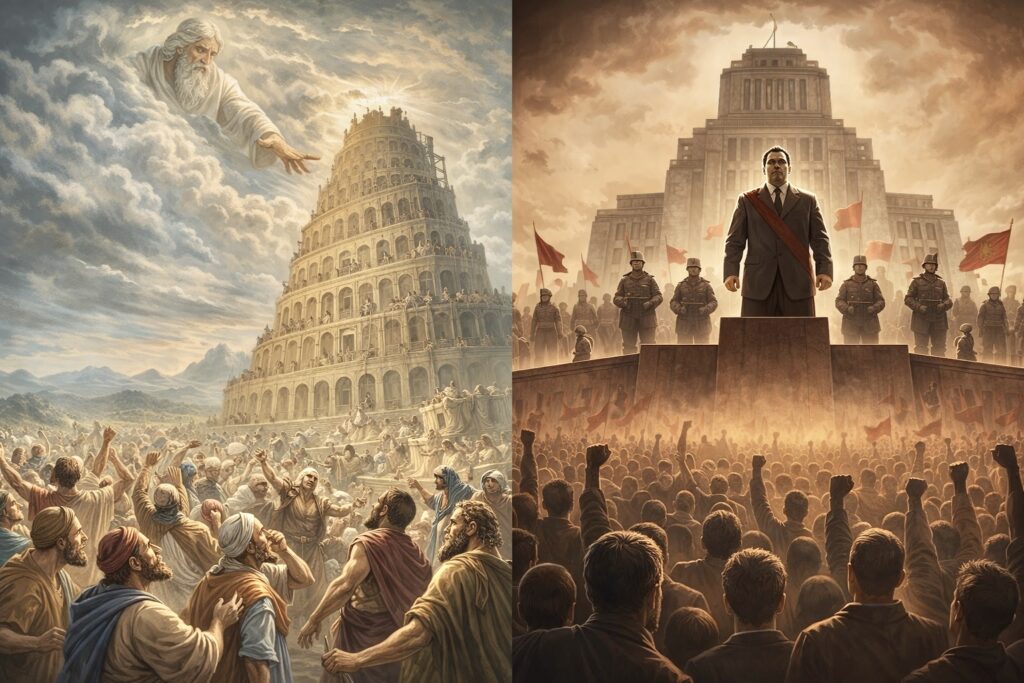
现代技术解决的是表达效率,却无法解决人心方向。技术是一种放大器,它可以放大善意,也可以放大野心。当人的中心仍然是权力、荣耀与控制欲时,技术只会让塔建得更高、更快、更隐蔽。
巴别塔并未消失,它只是换了形态。它可能是军事优势、经济扩张、意识形态输出、数据控制,也可能是个人在权力结构中的攀升。它的核心始终相同——“让我们为自己立名”。
若人类拒绝承认自己的有限,拒绝在神面前谦卑,那么任何制度、任何科技进步,都无法带来真正的和睦。表面的分歧也许源于价值观与文化差异,但深层的根源,是人心对神位置的拒绝。
然而,在批评“世界”的同时,我也不得不承认,巴别塔的倾向并非只存在于国家层面,也存在于我自己之中。当我渴望影响力、话语权、认同感,当我在争论中急于证明自己正确,当我希望自己的观点被更多人看见,那种“为自己立名”的冲动,何尝不是塔的雏形?
若我指责权力的骄傲,却不省察自己的骄傲,那么我的反对,不过是另一种形式的竞争。因此,真正的对抗不是人与人之间的对抗,而是人与罪性之间的对抗。圣经提醒我们,我们的争战并不是与属血气的争战。权力之争背后的真正力量,是人心对控制与荣耀的渴望。
在阴霾国当下的自媒体时代,每个人都拥有某种程度的“建塔能力”。一个账号、一段视频、一篇文章,都可以迅速聚集关注。表达的自由带来了可能,也带来了试探。我们可以用它传播真理,也可以用它制造对立;可以用它唤醒良知,也可以用它煽动愤怒。若传播只是出于愤怒与对抗,那么塔会在另一种旗帜下重建。若表达缺乏爱与敬畏,即便语言再精准,也无法带来真实的和解。
如何打破这种不断堆高的塔?
答案不在更强的对抗,而在更深的谦卑。不是以暴制暴,而是以爱覆盖;不是用更高的塔压制旧塔,而是在内心承认神的主权。
真正的改变,往往从最小的单位开始——一个人拒绝说谎,一个家庭拒绝以恐惧驱动关系,一个群体坚持诚实与怜悯。当越来越多的人在内心承认神的位置,那些以权力为核心的结构,终将失去根基。
语言不再是障碍,却暴露了更深的事实:人类的问题,从来不是沟通工具的不足,而是敬畏的缺失。
当技术高度发达,而人心却缺乏方向时,巴别塔会再次出现;当人愿意在神面前谦卑时,即便语言不同,也能彼此理解。
或许,真正的“人类共同体”不是建立在技术统一之上,而是建立在共同承认神主权之上。若没有这一点,再先进的翻译系统,也无法翻译人心的隔绝。这样的改变不会一夜之间改变世界格局,但它可以改变一个人、一家人、一个群体。当越来越多的人在内心深处拒绝为自己立名,而愿意荣耀神,那些高耸入云的塔,终将失去根基。
When Language Is No Longer a Barrier,Why Are Human Hearts Still Divided?
— A Spiritual Reflection from the Tower of Babel to the Technological Age
By HuSir
A few days ago, while discussing conflicts between nations and tensions among people with a friend, I suddenly thought of the story of the Tower of Babel in Genesis. At that time, humanity shared one language, communication was smooth, and they united to build a tower reaching to the heavens in order to “make a name for themselves.” God confused their language, making it difficult for them to understand one another, and the project came to a halt.
Many interpret the Tower of Babel as a “language problem,” yet what was truly restrained was not technology itself, but a collective pride—the attempt to establish human glory in the place where God should stand.
Today’s world is drastically different from the ancient one. Translation software can instantly cross linguistic boundaries. Artificial intelligence can generate cross-cultural expression. Information flows with almost no borders. From a technical perspective, humanity has once again “unified its language.” And yet communication has not become more authentic. Conflicts remain, even growing more complex. Ideological confrontation, national interest competition, and tensions of identity make the idea of a “shared destiny of humankind” difficult to realize.
This suggests that the problem has never been language.
Modern technology improves the efficiency of expression, but it cannot correct the direction of the human heart. Technology is an amplifier—it magnifies goodwill, but it also magnifies ambition. When power, glory, and control remain at the center of human desire, technology only allows the tower to be built higher, faster, and more subtly.
The Tower of Babel has not disappeared; it has simply changed its form. It may appear as military dominance, economic expansion, ideological export, data control, or the individual ascent within structures of power. Yet its core remains unchanged: “Let us make a name for ourselves.”
If humanity refuses to acknowledge its limits and refuses to humble itself before God, then no system and no technological advancement can bring true harmony. Surface-level divisions may stem from differences in values or culture, but at a deeper level, the root lies in the human heart’s rejection of God’s rightful place.
However, while critiquing “the world,” I must also admit that the tendency of Babel does not exist only at the level of nations; it exists within myself. When I long for influence, recognition, and affirmation; when I am eager to prove myself right in an argument; when I desire that my views be seen by more people—are these not seeds of the same tower-building impulse?
If I condemn the pride of power but fail to examine my own pride, my opposition becomes merely another form of competition. Thus, the true conflict is not between people, but between humanity and sin. Scripture reminds us that our struggle is not against flesh and blood. Behind struggles for power lies the human heart’s craving for control and glory.
In today’s self-media era within the “Land of Shadows,” each person possesses a certain degree of “tower-building capacity.” An account, a video, an article—any of these can rapidly gather attention. The freedom of expression creates opportunity, but it also creates temptation. We can use it to spread truth, or to deepen division; to awaken conscience, or to stir anger. If communication arises merely from rage and confrontation, the tower will be rebuilt under a different banner. If expression lacks love and reverence, even the most precise language cannot produce genuine reconciliation.
So how can we dismantle this ever-rising tower?
The answer does not lie in stronger confrontation, but in deeper humility. Not in repaying violence with violence, but in covering with love. Not in replacing one tower with a taller one, but in acknowledging God’s sovereignty within our hearts.
True change often begins with the smallest units—a person refusing to lie; a family refusing to let fear govern relationships; a community insisting on honesty and mercy. When more and more people acknowledge God’s rightful place in their hearts, structures built upon power will gradually lose their foundation.
Language is no longer the obstacle, yet this reveals a deeper reality: humanity’s problem has never been the inadequacy of communication tools, but the absence of reverence.
When technology advances rapidly while the human heart lacks direction, Babel reappears. When people humble themselves before God, even different languages cannot prevent mutual understanding.
Perhaps the true “human community” is not founded upon technological unity, but upon a shared acknowledgment of God’s sovereignty. Without this, even the most advanced translation systems cannot translate the division within human hearts. Such change will not transform the global order overnight, but it can transform one person, one family, one community. And when more and more people refuse to make a name for themselves and instead choose to glorify God, those towering structures that seem to reach the heavens will ultimately lose their foundation.