——一次中年人的信仰反省
文 / HuSir
这段时间,我心里有一些并不轻松、却很真实的反省,想和弟兄姐妹分享。
到了我们这个年龄,身体多少都会出问题。睡眠不好、情绪波动、血压异常、胸口不适、胃口紊乱,甚至有些弟兄姐妹出现抑郁倾向……这些情况,并不是简单地“想开点”就能解决的。去诊所找大夫把脉、吃汤药,甚至长期服药,对很多中年人来说,都是现实而无奈的选择。我自己也正在经历这些。这本身并不是如同某些极端信仰所说的不信神的表现,更谈不上犯罪。
但在最近的过程中,我慢慢意识到一个让我感到惭愧、也不得不正视的问题。
其实不只是最近这两周亲自去诊所、吃中药。回头看这两年,只要身体一有不适,我的第一反应往往不是安静下来祷告、悔改、交托,而是先断定这是身体问题,立刻上网搜索症状、查资料、找解决办法。每天吃一些看起来“很对路”的药,再加上网络上那些“评价不错”的反馈,感觉这些方法似乎也很科学、很积极,但实际效果并不明显。更多的时候,只是给了我一种心理安慰——至少我在“处理问题”,至少我还掌控着局面。
慢慢地,我才意识到,自己对药物的依赖,已经不完全是为了治病,而是在寻找一种确定感和安全感。好像只要手里有药、有方案,就还能撑住;而在祷告和悔改中,反而没有那么彻底地把自己交出来。虽然我也隐约意识到,这些症状中有不少与过往经历有关,与由此产生的情绪和思想状态相关,但却始终不太愿意沿着这个方向,去认真寻求更深层次的“根治”。
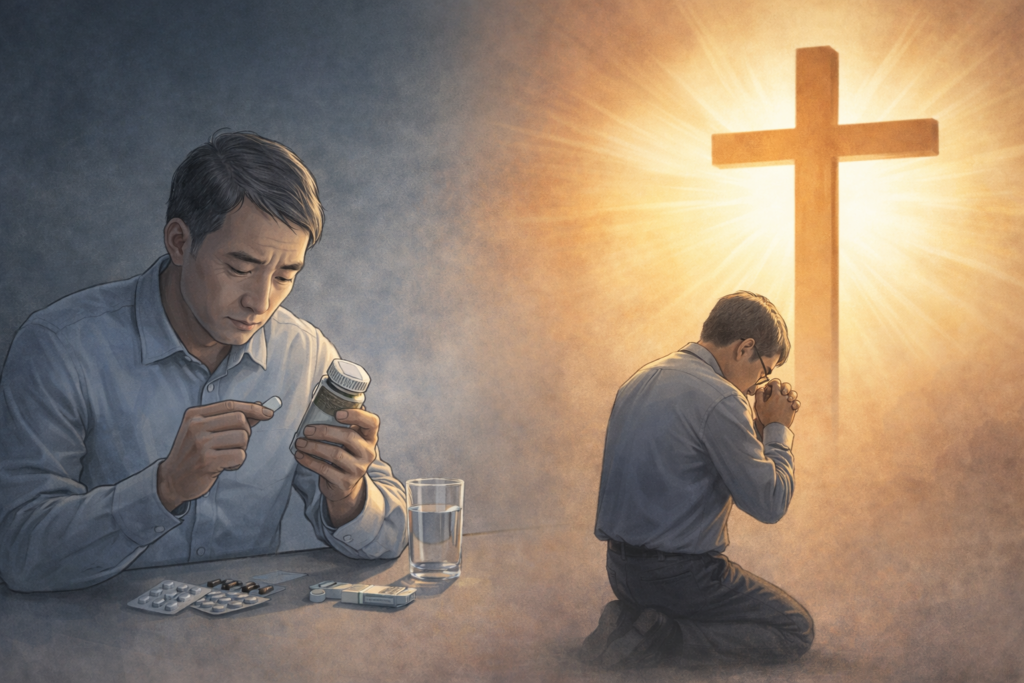
这让我开始警醒:问题也许并不在于“吃不吃药”,而在于——当问题出现时,我第一时间倚靠的究竟是什么。
药物本身是工具,是神也允许、甚至赐下的帮助方式,它可以医治身体,这一点我并不否认。但我越来越清楚地看到,如果悔改只是停留在口头,而没有进入真实的交托和行动深处,那么再好的工具,也很容易被我不自觉地抬到了一个不该有的位置。
身体的病,很多时候只是表层。真正更深的,往往是长期的紧绷、惧怕、硬撑,以及不肯放手的内在状态。我们习惯第一时间靠自己解决问题,却不太愿意先停下来,来到神面前。
在这样的反省中,我忽然意识到,这种模式并不只存在于身体健康的问题上。在工作中、生活中、面对压力和选择时,我往往也是如此——习惯先分析、先制定对策、先控制、先硬顶,而不是先祷告、先省察、先把自己摆在神面前。
身体不适时,我急着找药;工作遇到难处时,我急着想办法;生活出现冲突时,我急着解释、应对、扛过去。表面上看,这是一种“负责任”“不逃避”的态度,但在更深的层面,其实反映的是同一个问题:我更相信自己的判断和掌控,而不是先信靠神的带领。
也正是在这一点上,我开始更真实地理解什么是悔改。悔改并不是对自己更苛刻,也不是要求自己“属灵表现更好”,而是承认一个事实:我已经撑得太久了,却仍然不愿意停下来,把控制权交出来。
药物可以医治身体,这是事实;但我越来越体会到,悔改若是深入而真实,神对人心灵的医治往往更深,也更有力量,甚至会反过来影响身体和生活的恢复。很多时候,我们的问题并不是缺少方法,而是缺少一次真正的松手。
所以对我来说,现在并不是一个“要不要停药”的问题,而是一个次序的问题。在继续接受医疗帮助的同时,学习不再把药物、方法和方案当作最后的倚靠,而是在祷告中悔改,在悔改的行动中不断求神与我同在。
这不是一次性的决定,而是一个持续学习松手、学习交托的过程。我自己也仍然在这条路上。

写下这些,并不是要给任何人增加属灵压力,而是想邀请弟兄姐妹,尤其是像我一样正承受着身体、家庭、工作多重压力的中年人,举一反三地省察:当问题出现时,我们的第一反应,究竟是奔向方法,还是回到神面前。
身体需要医治,心灵同样需要回到正确的位置。当我们愿意在神面前真正松下来,很多东西,才可能开始慢慢改变。
Medication, Repentance, and True Healing
— Between Treatment and Trust: A Midlife Reflection
By HuSir
During this period of time, I have found myself carrying some reflections that are not easy, yet very real, and I would like to share them with my brothers and sisters.
By the time we reach middle age, physical problems are almost unavoidable. Poor sleep, emotional fluctuations, abnormal blood pressure, chest discomfort, digestive issues, and even depressive tendencies among some brothers and sisters—these are not things that can be resolved simply by “thinking positively.” Visiting a clinic, consulting a physician, taking herbal medicine, or even relying on long-term medication has become, for many middle-aged people, a realistic and sometimes helpless choice. I myself am going through this as well. This, in itself, is not a sign of lacking faith in God, as some extreme religious views might suggest, nor is it a sin.
Yet during this recent period, I gradually became aware of an issue that left me both uneasy and inescapably confronted.
It is not only these past two weeks, during which I personally visited a clinic and took traditional medicine. Looking back over the past two years, whenever physical discomfort appeared, my first reaction was rarely to quiet myself in prayer, repentance, and surrender. Instead, I would quickly assume it was a purely physical problem, immediately search online for symptoms, consult information, and look for solutions. I took various medications that appeared “appropriate,” supported by positive online reviews. These approaches seemed scientific and proactive, yet the actual effects were limited. More often, they merely offered psychological comfort—at least I was “doing something,” at least I still felt in control.
Gradually, I realized that my reliance on medication was no longer solely about treatment. It had become a way of seeking certainty and a sense of security. As long as I had medicine in hand and a plan in place, I felt I could keep going. Meanwhile, in prayer and repentance, I was far less willing to fully surrender myself. Although I vaguely recognized that many of these symptoms were connected to past experiences and the emotions and thought patterns shaped by them, I remained reluctant to pursue a deeper path toward genuine healing.
This realization prompted a deeper alertness within me: perhaps the issue is not whether one should take medication, but rather what—or whom—I turn to first when problems arise.
Medication itself is a tool, one that God permits and even provides. It can heal the body, and I do not deny this. Yet I have become increasingly aware that if repentance remains only verbal, without entering into real surrender and concrete action, even the best tools can unconsciously be elevated to a place they were never meant to occupy.
Physical illness is often only the surface. What lies beneath is frequently prolonged tension, fear, endurance, and an unwillingness to let go. We are accustomed to relying on ourselves to solve problems immediately, while hesitating to pause and come before God first.
In this reflection, I suddenly realized that this pattern extends far beyond physical health. In my work, daily life, and moments of pressure or decision-making, I often respond in the same way—analyzing first, devising strategies first, attempting control, and pushing through—rather than praying first, examining myself first, and placing myself before God.
When my body feels unwell, I rush to find medicine. When work becomes difficult, I rush to find solutions. When conflicts arise in life, I rush to explain, respond, and endure. On the surface, this appears to be a responsible, proactive attitude. Yet at a deeper level, it reveals the same issue: I trust my own judgment and control more than I trust God’s guidance.
It is precisely here that I began to understand repentance more truthfully. Repentance is not about being harsher with oneself, nor about striving for better “spiritual performance.” It is the acknowledgment of a simple fact: I have been holding on for far too long, yet I am still unwilling to stop and release control.
Medication can heal the body—this is true. But I have increasingly experienced that when repentance is genuine and thorough, God’s healing of the human heart often goes much deeper and carries greater power, sometimes even influencing physical recovery and daily life. Often, what we lack is not methods, but a truly surrendered release.
Therefore, for me, the question now is not whether to stop taking medication, but one of order and priority. While continuing to receive medical help, I am learning not to treat medication, methods, or plans as my ultimate reliance, but instead to repent in prayer and continually seek God’s presence through the actions of repentance.
This is not a one-time decision, but an ongoing process of learning to let go and to entrust. I myself am still walking this path.
I write these words not to place spiritual pressure on anyone, but to invite my brothers and sisters—especially middle-aged believers who, like me, bear the combined weight of physical strain, family responsibility, and work pressure—to reflect by analogy: when problems arise, do we instinctively run toward solutions, or do we return first to God?
The body needs healing, and the heart likewise needs to be restored to its proper place. When we are willing to truly relax before God, many things may begin to change, slowly but surely.