
——关于真相、细节与普通人的胆魄
文 / HuSir
简介
狄仁杰(630—700),唐代名臣,以刚正善断著称。他并非依靠权势破案,而是凭借细致勘查、审慎判断,以及在面对邪恶时不退却的胆魄。后世关于他的诸多传奇,其实并不只是对一位能臣的赞美,更是一种人格理想的投射——在恐惧之中,仍然选择尊重事实与真相。
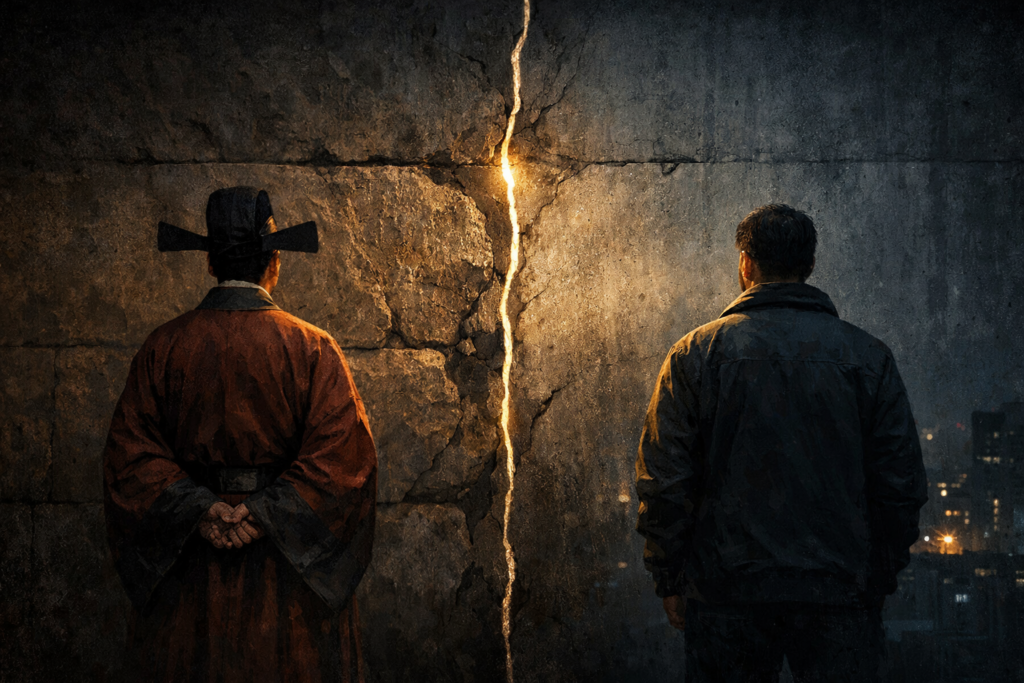
很多人谈起断案故事,总会下意识提到狄仁杰,仿佛只有这样的人,才有资格接近真相。但如果把这些故事从传奇中抽离,放回现实,就会发现一个更接近事实的判断:狄仁杰之所以能破案,并不是因为他比别人聪明多少,而是因为他没有放弃大多数普通人被反复训练去放弃的三件事——对细节的耐心、对结论的克制,以及在恐惧面前不提前退场的胆魄。
由此也引出一个更现实的问题:当我们面对现实生活中那些看似坚不可摧的结构时,究竟该持有怎样的心态?
一、邪恶之所以显得牢固,是因为太多人在心理上提前撤退
在现实生活中,许多明显不合理的事件,在尚未被真正审视之前,就已被视为“不可撼动”。它们拥有完整说法、统一口径、权威背书,看起来逻辑自洽、程序完备,像一座修筑严密的大坝。
于是,大多数普通人会在心里对自己说:这件事太复杂,背后力量太大,不是我能弄明白的,想多了也没用。
这并非因为人们愚钝,而是在长期高压环境中,人们逐渐学会了一种理性自保——在恐惧面前,尽量少看、少想、少判断。而正是在这个时刻,真相开始显得“坚不可破”。
二、所谓“破案”,不是灵光乍现,而是拒绝被结论牵着走
在狄仁杰的断案故事中,真正值得注意的,并不是某个惊人的反转,而是他一贯的做法:不从结论入手,而从不协调之处开始。
以扬州“铁手团”一案为例。案件初现时,几乎没有任何破绽:受害者多为“合理死亡”,证词彼此印证,地方官员态度一致,账目、手续、时间线完整闭合。
从表面看,这是一套高度自洽的叙事结构,仿佛一座没有缝隙的堤坝,足以压住所有怀疑。但狄仁杰关注的,并不是“大结构”,而是细节中的异常:证词过于一致,反而缺乏真实世界应有的差异;不同案件中,关键人物的反应模式高度重复;个别路径、时间、动机之间存在微妙错位。
这些细节单独看,并不足以推翻任何结论。但当它们被耐心核对、连续比对、逻辑串联时,一个隐藏的结构逐渐浮现——一个依靠恐惧与暴力维持秩序的地下网络。真正击穿那座大坝的,不是某个天才判断,而是长期、不间断、不被权威打断的核查。
三、关键不在于智慧,而在于“不放弃相信裂缝存在”
许多社会问题之所以长期存在,并不是因为它们多么高明,而是因为大多数人在心理上已经接受了一个前提:“这件事太大了,不可能被看清。”
而狄仁杰拒绝接受这个前提。他始终相信:凡是人为构造的结构,必然存在人为失误;凡是依靠谎言维持的秩序,必然无法在所有细节上自洽。
这种相信,本身就是一种胆魄。人们之所以在后来仍然反复讲述他的故事,或许正因为在潜意识中,每个人都希望自己也能保有这种品质。
四、普通人真正失去的,不是能力,而是“继续看下去”的勇气
在现实中,绝大多数普通人并非看不懂问题,而是在某个节点选择了不再继续看。因为继续看下去,意味着心理不适、自我怀疑、风险上升,以及情绪与安全成本的增加。
久而久之,人们学会了一种被称为“成熟”的生存方式:看个大概就好,别深究,别追问。这种态度不仅作用于个人,也在不知不觉中被传递给下一代,仿佛在复杂现实面前保持沉默,才是“理性”的标志。
而正是在这个节点,判断能力开始萎缩,权威叙事开始变得牢不可破。
五、现实中的历练:不对抗,也不自我关闭
这种心智选择,并非只存在于历史故事中。
在现实中国,许多基层医务人员、工程技术人员、审计人员或教师,在面对明显不合理的数据、流程或结论时,并未立刻顺从,也未公开对抗,而是选择默默核对、反复确认、保留记录。
他们未必改变了结果,却为自己保留了三样东西:不把明显错误说成“合理”,不因权威而放弃专业判断,不在内心彻底关闭思考通道。这种行为看似微小,却是一种极其重要的内在历练。
因为一个社会真正危险的,不是错误存在,而是所有人都在心里默契地说一句:“算了,没必要再想。”
六、没有人需要成为英雄,但不能提前把真相判死刑
没有人要求普通人去推倒大坝,也没有要求每个人都成为这个社会的“手术刀”。真正重要的,是不要在心理上提前投降。
邪恶真正依赖的,并不是它的高明,而是人们在内心深处反复接受了这样一句话:“这道坝,攻不破。”一旦这句话被内化,任何结构都会因无人质疑而显得稳固。
结语
今天再提狄仁杰的意义,不在于他是谁,而在于他代表了一种尚未完全消失的心智状态:相信裂缝存在,愿意顺着细节继续看,并拒绝在恐惧中提前撤退。
这不是英雄的专利,而是每一个普通人仍然可以为自己保留的一种尊严,也为自己预留了一张入场券,去见证那些看似牢不可破的结构,最终在真相面前失效的时刻。这也是一个人在时代压力之下,仍不被完全吞没的方式。
No One Needs to Become Di Renjie
— On Truth, Details, and the Courage of Ordinary People
By HuSir
Introduction
Di Renjie (630–700) was a prominent statesman of the Tang dynasty, renowned for his integrity and decisiveness in judgment. He did not rely on power to solve cases, but on meticulous investigation, cautious reasoning, and the courage not to retreat when confronting evil. The many legends that later generations tell about him are not merely praise for a capable official; they are also a projection of an ideal character—one that, even in the midst of fear, chooses to respect facts and truth.
Many people, when speaking of judicial cases, instinctively invoke Di Renjie, as if only someone like him were qualified to approach the truth. Yet if these stories are stripped of their legendary aura and placed back into reality, a more grounded conclusion emerges: Di Renjie was able to solve cases not because he was vastly more intelligent than others, but because he refused to abandon three things that most ordinary people are repeatedly trained to give up—patience with details, restraint toward conclusions, and the courage not to exit the scene prematurely when faced with fear.
This, in turn, raises a more realistic question: when we confront structures in real life that appear unshakable, what kind of mindset should we adopt?
I. Evil Appears Solid Because Too Many People Withdraw Mentally in Advance
In real life, many clearly unreasonable events are already regarded as “unmovable” before they are ever seriously examined. They come with complete narratives, unified accounts, and authoritative endorsements. They appear logically consistent and procedurally flawless, like a tightly constructed dam.
As a result, most ordinary people tell themselves: this is too complicated; the forces behind it are too powerful; it is beyond my ability to understand; thinking about it further is pointless.
This is not because people are foolish. Rather, under prolonged high-pressure conditions, they gradually learn a form of rational self-preservation—minimizing observation, reflection, and judgment in the face of fear. It is precisely at this moment that truth begins to appear “indestructible.”
II. “Solving a Case” Is Not a Flash of Insight, but a Refusal to Be Led by Conclusions
In Di Renjie’s case-solving stories, what truly deserves attention is not a dramatic reversal, but his consistent approach: he did not begin with conclusions, but with points of inconsistency.
Take the “Iron Hand Group” case in Yangzhou as an example. When the case first emerged, there appeared to be no flaws at all. The victims were classified as “reasonable deaths”; testimonies corroborated one another; local officials presented a unified stance; accounts, procedures, and timelines formed a closed and coherent whole.
On the surface, this was a highly self-consistent narrative structure, like a seamless dam capable of suppressing all suspicion. Yet what Di Renjie focused on was not the “grand structure,” but anomalies in the details: testimonies that were too consistent, lacking the natural variation of real life; identical reaction patterns among key figures across different cases; subtle misalignments among routes, timing, and motives.
Viewed in isolation, these details were insufficient to overturn any conclusion. But when they were patiently examined, repeatedly compared, and logically connected, a hidden structure gradually emerged—a subterranean network that maintained order through fear and violence. What truly breached the dam was not a single brilliant judgment, but long-term, uninterrupted verification that was not interrupted by authority.
III. The Key Is Not Intelligence, but the Refusal to Abandon the Belief That Cracks Exist
Many social problems persist for long periods not because they are exceptionally sophisticated, but because most people have already accepted a psychological premise: “This is too big to be seen clearly.”
Di Renjie refused to accept this premise. He consistently believed that any structure constructed by humans must contain human errors, and that any order sustained by lies cannot remain self-consistent in every detail.
This belief itself is a form of courage. Perhaps this is why later generations continue to retell his stories—because, at a subconscious level, people hope that they, too, might retain such a quality.
IV. What Ordinary People Truly Lose Is Not Ability, but the Courage to Keep Looking
In reality, most ordinary people are not incapable of understanding problems; rather, at some point, they choose to stop looking further. Continuing to look means psychological discomfort, self-doubt, increased risk, and rising emotional and security costs.
Over time, people learn what is called a “mature” way of living: seeing the general outline is enough; do not probe deeply; do not ask too many questions. This attitude not only shapes individuals, but is also unconsciously passed on to the next generation, as if remaining silent in the face of complex reality were a sign of rationality.
It is at this very point that judgment begins to wither, and authoritative narratives become unassailable.
V. Real-Life Discipline: Neither Confrontation nor Self-Closure
This mental stance does not exist only in historical stories.
In contemporary China, many grassroots medical workers, engineers, auditors, or teachers, when faced with clearly unreasonable data, procedures, or conclusions, do not immediately comply, nor do they openly confront authority. Instead, they quietly verify, repeatedly confirm, and retain records.
They may not change the outcome, but they preserve three things for themselves: they do not label obvious errors as “reasonable”; they do not abandon professional judgment because of authority; and they do not completely shut down their capacity to think internally. This behavior may appear insignificant, yet it represents an extremely important form of inner discipline.
For what truly endangers a society is not the existence of errors, but the silent consensus in which everyone tells themselves: “Forget it, there’s no need to think about it anymore.”
VI. No One Needs to Be a Hero, but Truth Must Not Be Sentenced to Death in Advance
No one demands that ordinary people tear down dams, nor that everyone become a “scalpel” for society. What truly matters is not surrendering psychologically in advance.
What evil truly relies on is not its cleverness, but the repeated internalization of a single sentence: “This dam cannot be breached.” Once this sentence is absorbed, any structure will appear stable simply because no one questions it.
Conclusion
The significance of invoking Di Renjie today lies not in who he was, but in what he represents: a mental state that has not yet completely disappeared—believing that cracks exist, being willing to follow details further, and refusing to retreat prematurely in the face of fear.
This is not the privilege of heroes. It is a form of dignity that every ordinary person can still preserve for themselves, and a way of reserving a place to witness the moment when structures that once seemed unbreakable ultimately fail in the face of truth. It is also a way for an individual not to be completely swallowed by the pressures of their time.