——写给转型时代的阴霾国人
文 / HuSir
前言
在这篇文章里,不会有煽动情绪,也不会有发泄不满,甚至暂且不去讨论那位权力核心的治理风格,也不深入剖析从上到下那一层层工具式的管控逻辑,更不准备从那些南方美好朋友、非洲朋友、中亚朋友的相继衰落中,去总结什么沉痛的经验教训。本文只想提出一个更简单、也更根本的问题:那些已经习惯、甚至开始喜欢一天做两次核酸的阴霾国人民,究竟渴望一个怎样的未来社会?又希望过一种怎样的人生?这个问题与意识形态无关,与阵营无关,甚至与政治形式无关,它仅仅关乎一件事——人如何理解自己的一生。
历史的一个冷规律
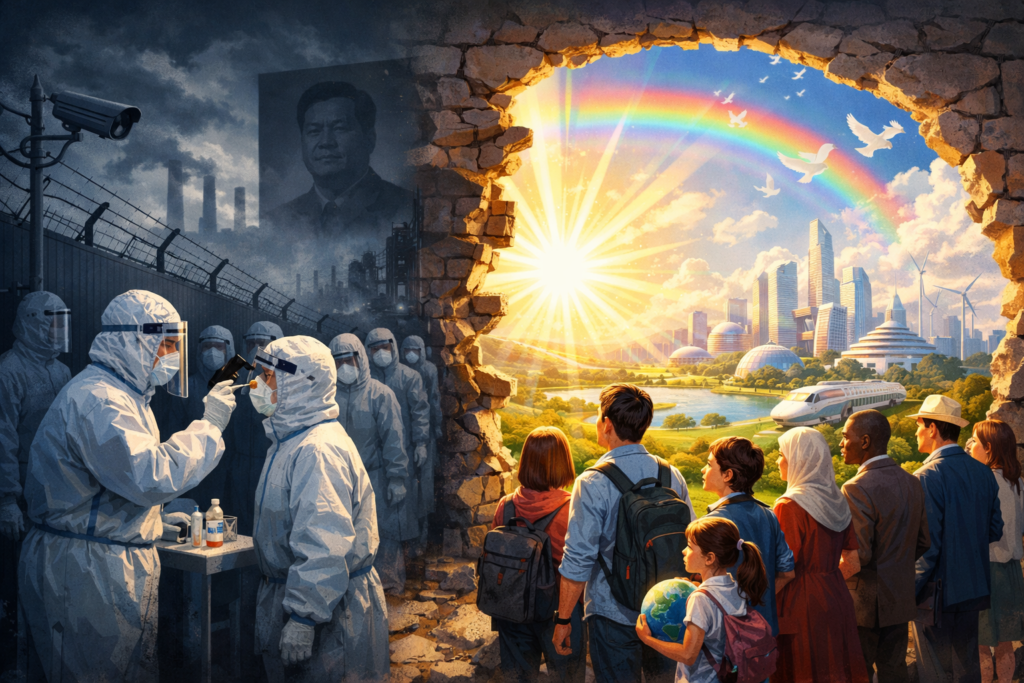
人类历史反复印证一条残酷却真实的规律:当一个社会丧失了清晰、可信、可参与的未来图景,强权往往会再次被视作“希望”的化身。从尧、舜、禹的部落共主时代开始,阴霾国的统治结构几乎始终围绕“权力集中—更替—再集中”的循环展开。夏商周以血缘和神权为核心,秦用法家极权打造国家机器,汉以后形成皇权与官僚的稳定模型,唐宋曾凭借制度治理短暂缓和集权,明清则将个人专制推向近乎顶峰。每一次王朝更迭,形式或许不同,但权力逻辑从未真正改变,不过是换汤不换药。到了近代,无论是军阀混战、党国体制还是意识形态国家,这一线索依然贯穿始终。今天,在目睹某些“国际好朋友”悲惨下场后,阴霾国中不少人忽然对“强力秩序”生出强烈幻想;当看到黄头发的大帅哥站出来撑腰时,甚至有人激动到不能自已。这并不是因为人们天生热爱被统治,而是在恐惧与不确定中,他们从他人的遭遇里读出了一个结论:一个看似良好的社会秩序,竟比自由更具吸引力。可问题是,事情真的如此简单吗?
一、最大的危险不是旧权力,而是“无未来感”
转型时代最危险的阶段,从来不是旧秩序的顽强存在,而是旧叙事正在崩解,而新叙事尚未成形。在这个叙事真空期,人们普遍陷入四种心理状态:对未来丧失想象能力、对不确定性极度恐惧、对“快速解决方案”产生依赖、对强力秩序形成心理依附。今天的社会现实已清晰显现这种状态——就业结构持续收缩,中产焦虑普遍蔓延,年轻人对努力与回报失去信心,家庭对教育、养老、医疗充满深切不安。在这样的环境下,自由显得遥远而抽象,秩序却具体而安全。这正是极权反复出现的温床。
二、如果觉醒只是否定,极权必然重生
许多人以为,只要推翻旧的控制,世界就会自然变好。历史却一次次否定了这种天真幻想。如果觉醒仅仅停留在否定枷锁,却无法提供新的未来结构,人们最终会主动寻找新的枷锁。东德并入西德后,整整两代人经历了严重的心理不适应:身份失落、尊严重建困难、价值观错位。制度改变了,人的内在结构却来不及跟上。这正是许多革命最终沦为悲剧的根源——旧权力倒下,新权力迅速集中,极权以崭新的名义悄然回归。
三、有效的觉醒,是文明型觉醒
真正有效的觉醒,不只是摆脱压迫,而是主动承担文明使命;不只是知道“不要什么”,而是明确要建设什么。今天的人类已进入“世界公司”时代:气候、能源、科技、金融、风险治理,没有任何一个国家能独力完成。在这个全球结构中,阴霾国不应仅仅是被管理者或对抗者,而必须成为负责任的文明事业部。觉醒的核酸人,不是为了建立新的权力集团,而是在这片土地上,自发构建透明、可协作、可审计的社会组织架构,并逐步与世界文明体系融为一体,如此才有资格与世界上那些漂亮的国家和正在变漂亮的国家一起共享人类文明的成果,而不是在资本主义初级阶段反复徘徊,如同一个长不大的流浪儿。
四、如果核酸人民看不到这个未来,就会再次投向强权
这是最现实、也最危险的事实:如果人民看不到参与世界文明的具体路径,看不到尊严的真实来源,看不到个人在未来中的位置,他们一定会再次将命运交给任何承诺“稳定与拯救”的权力集团。历史上几乎所有夺权者,无一例外先以美好许诺赢得人心,久而久之却恢复集权的本来面目。区别只在于口号,而不在本质。阴霾国社会至今从未系统性地讨论过民主与极权的关系、权力与责任的边界、个人与国家的真正位置,于是循环一次次重演。
五、真正的免疫力来自人的内在重建
一个民族要真正摆脱极权轮回,靠的不是推翻多少次权力,而是完成一项更为艰难的工程——人的内在结构重建。当人们开始认真追问“我为什么而活”“我的尊严从何而来”“权力应当服从什么”“苦难如何被承载与医治”“生命是否具有超越现实的意义”,自由才会有根基,秩序才不会再次沦为枷锁。阿根廷、智利等国家反复的动荡,正是内在结构重建迟缓的典型例证:制度可以不断更迭,但人心若未改变,轮回仍将持续。
再回想一下,罗马共和国从共和国于公元前509年建立,持续到公元前27年(屋大维获“奥古斯都”称号,进入帝国时期),那时中国已是西汉中期(汉武帝之后)。罗马的“议会”传统(元老院+公民大会)开始时,中国春秋战国时期还处于完全没有所谓制度的形态,那时中国是分封制向中央集权郡县制转型的关键阶段,而罗马则是从王政向贵族共和+混合政体的独特路径。两者虽同为古典文明巅峰,却走出了截然不同的政治道路。
六、给转型时代的一句提醒
如果未来不可见,强权就会再次成为核酸人的“希望”,特权便会换一种形态存在,人与人之间的平等也会再次落空;如果人的心灵没有重建,世界只会更换新的锁链。真正的觉醒,不是终结一套统治,而是让一个民族重新学会如何作为文明共同体的成员而生活。当你看到自由国家中不同文化、不同信仰、不同族群,在规则与尊严之下协作共存;当你看到“世界公司”携手应对人类共同命运的挑战——那不是遥远的幻象,那正是阴霾国人民有可能拥有的未来图景。前提只有一个:你愿意为这样的未来,重建自己的人生信仰与生命秩序。
What Future and Hope Do the “Nucleic-Acid People” Long For?
— To the People of the Shadowed Nation in an Age of Transition
By HuSir
Preface
In this article, there will be no emotional agitation, nor will there be any venting of grievances.
I will not, for the moment, discuss the governing style of the core power structure, nor will I analyze in depth the layered, instrumental mechanisms of control from top to bottom.
I also do not intend to draw painful lessons from the successive decline of our “good friends” in South America, Africa, or Central Asia.
Instead, I wish to raise a simpler and more fundamental question:
What kind of future society do the people of the Shadowed Nation — those who have already grown accustomed to, and even begun to like, taking nucleic acid tests twice a day — truly long for?
And what kind of life do they hope to live?
This question has nothing to do with ideology, nothing to do with camps, and not even with political forms.
It concerns only one thing: how a human being understands the meaning of one’s own life.
A Cold Law of History
Human history repeatedly confirms a cruel yet real rule:
when a society loses a clear, credible, and participatory vision of the future, strong power is often once again regarded as the embodiment of “hope.”
From the era of Yao, Shun, and Yu’s tribal co-leadership onward, the ruling structure of the Shadowed Nation has almost always revolved around a cycle of “centralization of power — replacement — renewed centralization.”
The Xia, Shang, and Zhou dynasties were built upon bloodline and divine authority.
The Qin dynasty forged a state machine through Legalist absolutism.
After the Han, a stable model of imperial power combined with bureaucracy took shape.
The Tang and Song dynasties briefly softened centralization through institutional governance.
The Ming and Qing dynasties pushed personal autocracy to near its peak.
Each dynastic transition differed in form, yet the logic of power never truly changed — merely old wine in new skins.
In modern times, whether through warlord chaos, party-state systems, or ideological regimes, the same thread continued.
Today, after witnessing the tragic fate of certain “international friends,” many within the Shadowed Nation suddenly develop powerful fantasies about “strong order.”
When they see a blond-haired strongman step forward in support, some even become wildly excited.
This is not because people are born loving to be ruled,
but because in fear and uncertainty, they read one conclusion from the experiences of others:
a seemingly good social order appears more attractive than freedom.
But is the matter truly so simple?
I. The Greatest Danger Is Not Old Power, but “No Sense of Future”
The most dangerous phase of an age of transition is never the stubborn existence of the old order,
but the collapse of the old narrative before a new one has formed.
In this narrative vacuum, four psychological states commonly emerge:
- loss of the ability to imagine the future
- extreme fear of uncertainty
- dependence on “quick solutions”
- psychological attachment to strong authority
Today’s social reality already displays these conditions clearly:
shrinking employment structures, spreading middle-class anxiety,
young people losing confidence in the relationship between effort and reward,
families filled with deep insecurity about education, healthcare, and old age.
In such an environment, freedom appears distant and abstract,
while order feels concrete and safe.
This is precisely the soil in which authoritarianism repeatedly grows.
II. If Awakening Is Only Negation, Authoritarianism Will Inevitably Return
Many believe that once the old controls are overthrown, the world will naturally become better.
History repeatedly denies this naïve hope.
If awakening remains only at the level of rejecting shackles,
yet fails to provide a new structure for the future,
people will eventually seek new shackles on their own.
After East Germany merged into West Germany,
two full generations suffered serious psychological maladjustment:
loss of identity, difficulty rebuilding dignity, distortion of values.
Institutions changed, but inner structures of the human spirit could not keep pace.
This is the root of many revolutionary tragedies:
old power falls, new power rapidly concentrates,
and authoritarianism quietly returns under a new name.
III. Effective Awakening Is Civilizational Awakening
True and effective awakening is not merely escaping oppression,
but actively assuming civilizational responsibility;
not merely knowing what to reject,
but clearly understanding what must be built.
Humanity has now entered the era of the “world company”:
climate, energy, technology, finance, risk governance —
no nation can complete these tasks alone.
Within this global structure, the Shadowed Nation should not remain merely a subject of management or confrontation,
but must become a responsible division of civilization.
The awakened “nucleic-acid people” do not seek to establish a new power group.
They must, on this land,
spontaneously build transparent, cooperative, auditable social structures,
and gradually integrate with the global civilizational system.
Only then can they share in the achievements of human civilization alongside those countries that are already beautiful and those becoming beautiful —
rather than wandering endlessly in the primitive stages of capitalism like a child who never grows up.
IV. If the People Cannot See This Future, They Will Again Turn to Strong Power
This is the most realistic and most dangerous fact:
if the people cannot see a concrete path into global civilization,
cannot see the true source of dignity,
cannot see their personal place in the future,
they will once again hand their destiny to any power group that promises “stability” and “salvation.”
Almost every usurper in history first won the people’s hearts with beautiful promises,
only to gradually restore the true face of centralized rule.
The difference lies only in slogans, never in substance.
The Shadowed Nation has never systematically examined the relationship between democracy and authoritarianism,
the boundaries between power and responsibility,
or the true position of the individual in relation to the state.
Thus the cycle repeats endlessly.
V. True Immunity Comes from Inner Reconstruction
For a people to truly escape the cycle of authoritarianism,
the key is not how many times power is overthrown,
but whether a far more difficult project is completed:
the reconstruction of the inner structure of human beings.
When people seriously ask:
Why do I live?
Where does my dignity come from?
What must power submit to?
How is suffering to be borne and healed?
Does life possess meaning beyond immediate reality?
Only then does freedom gain roots,
and only then does order cease to become a shackle.
The repeated turmoil of Argentina and Chile exemplifies the danger of delayed inner reconstruction:
institutions may change again and again,
but if the human heart does not change,
the cycle continues.
Consider also that the Roman Republic, founded in 509 BC and lasting until 27 BC,
overlapped with China’s Western Han dynasty (after Emperor Wu).
When Rome was developing its parliamentary traditions (Senate + citizen assemblies),
China during the Spring and Autumn and Warring States periods remained in the crucial transformation from feudalism toward centralized commandery governance.
Though both civilizations reached classical peaks,
they walked radically different political paths.
VI. A Final Reminder for an Age of Transition
If the future becomes invisible, strong power will once again become the “hope” of the nucleic-acid people;
privilege will simply change its form,
and equality among human beings will once again collapse.
If the human spirit is not rebuilt, the world will merely exchange one set of chains for another.
True awakening is not the end of one system of rule,
but the rediscovery of how a people can live
as members of a civilizational community.
When you see free societies where different cultures, faiths, and peoples coexist under shared rules and dignity;
when you see the “world company” cooperating to confront humanity’s common destiny —
that is not a distant fantasy.
It is a future that the people of the Shadowed Nation can genuinely possess.
There is only one precondition:
are you willing, for such a future, to rebuild your life’s faith and inner order?